

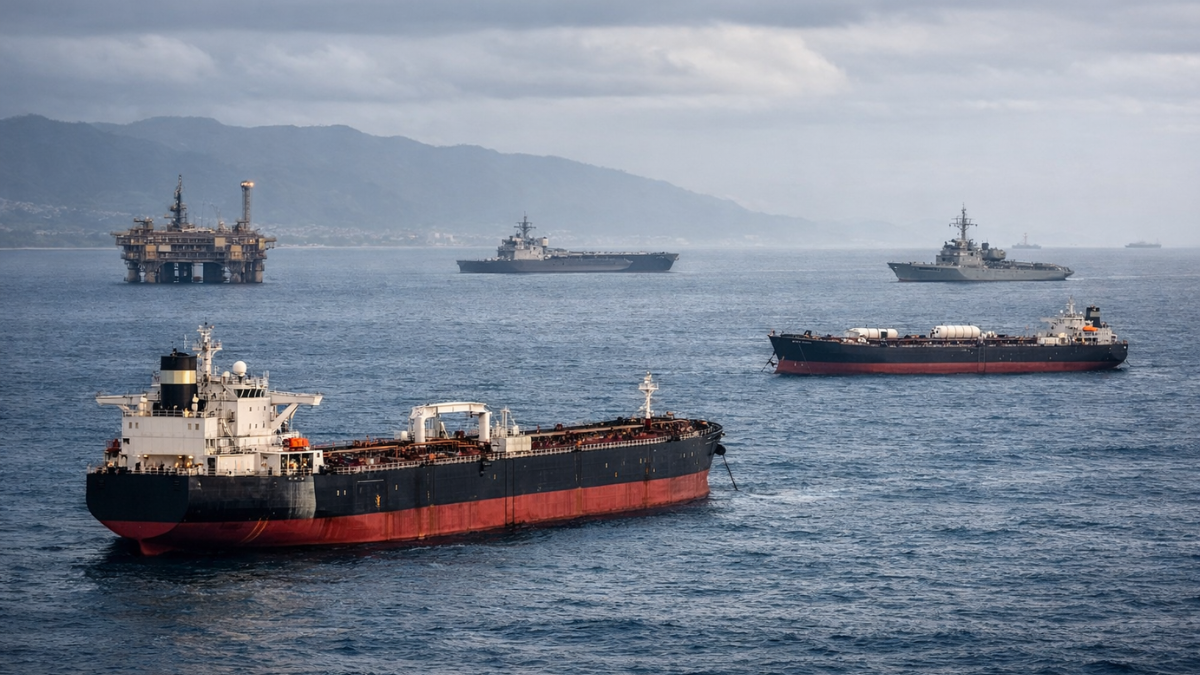


The United States has ordered a “total and complete blockade” of sanctioned oil tankers entering and leaving Venezuela, marking a sharp escalation in pressure on the South American nation. The action targets oil shipments, which are Venezuela’s main source of income, and has already affected global oil markets. The announcement has also increased political and military tensions in the region.
The order was announced by the U.S. administration, stating that Venezuela’s leadership has been designated as a foreign terrorist organization. The reasons given include alleged terrorism, drug smuggling, human trafficking, and the theft of foreign assets. Venezuela’s government has rejected the move and described it as a hostile and unacceptable threat against the country.
What the Blockade Means in Practice
The blockade applies specifically to oil tankers that are already under U.S. sanctions and are involved in transporting Venezuelan crude oil. These vessels are now barred from entering or leaving Venezuelan ports. The goal is to prevent sanctioned ships from exporting oil that brings in revenue for the government.
It remains unclear how the blockade will be enforced. Officials have not confirmed whether the Coast Guard or U.S. naval forces will directly stop and seize ships. However, the United States has moved thousands of troops and several warships into nearby waters, including an aircraft carrier. This military presence suggests the blockade could be enforced through direct action at sea.
The decision follows the recent seizure of a sanctioned oil tanker near Venezuela. Since that incident, many vessels carrying millions of barrels of oil have stayed in Venezuelan waters instead of risking interception. As a result, an effective embargo is already in place, even before full enforcement of the blockade order.
Not all vessels transporting Venezuelan oil are sanctioned. Some ships, including those operated under special authorizations, are still allowed to move oil. In addition, some tankers moving oil linked to Iran or Russia are not currently under sanctions.
Oil Market Reaction and Export Impact
Oil prices reacted quickly after the blockade announcement. U.S. crude oil prices rose by more than 1% during Asian trading. This came after prices had settled at their lowest level since early 2021. Market participants say the increase reflects concerns that Venezuelan oil exports could be reduced further.
Venezuela’s crude exports have already fallen sharply. The decline is linked to tanker seizures, fears of enforcement, and a recent cyberattack that disrupted the administrative systems of the state-run oil company. These issues have slowed shipping activity and made it harder for oil to leave the country.
Despite these disruptions, the global oil market remains well supplied. Millions of barrels of oil are currently stored on tankers offshore, particularly near China, waiting to be unloaded. However, analysts warn that if nearly one million barrels per day of Venezuelan supply are lost for an extended period, oil prices could rise more sharply.
Many buyers of Venezuelan oil rely on a so-called “shadow fleet” of tankers. These ships often hide their locations or use sanctioned vessels previously linked to other restricted oil trades. Data shows that more than 30 of the 80 tankers recently near Venezuelan waters were already under U.S. sanctions.
Legal Issues and Rising Tensions
The blockade order has raised serious legal questions. Under international law, blockades are traditionally considered acts of war and are only permitted under strict conditions. Legal experts say the move tests the limits of presidential authority under both domestic and international law.
Some U.S. lawmakers have described the blockade as an unauthorized act of war that has not been approved by Congress. These concerns have added to the political debate surrounding the decision.
Tensions are already high. Reports say U.S. forces have carried out more than two dozen strikes on vessels near Venezuela in recent weeks, resulting in at least 90 deaths. There have also been statements indicating that land-based military actions could soon begin.
Venezuela has accused the United States of attempting to overthrow its government and gain control of its oil and mineral resources. Officials say they will defend national sovereignty as military pressure and enforcement actions continue to increase.