

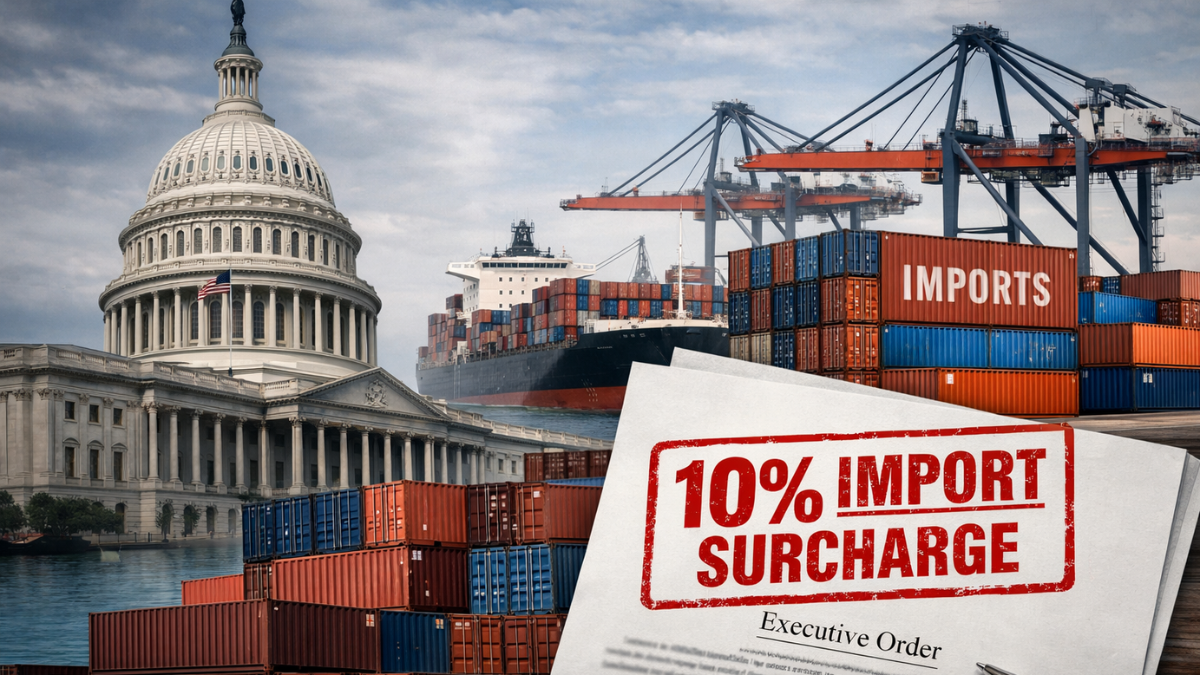


The United States is facing a major shift in trade policy after the Supreme Court of the United States struck down sweeping global tariffs imposed by President Donald Trump. Soon after the ruling, Trump ended certain tariff actions and signed a new executive order placing a 10% import surcharge on foreign goods.
The decision and the response have sparked intense debate across political and economic circles. The move affects global trade partners, including India, and changes how tariffs are applied in the United States.
Supreme Court Strikes Down Sweeping Tariffs
The Supreme Court delivered a 6-3 verdict that struck down President Donald Trump’s broad global tariffs. The court ruled that the administration had gone beyond its legal authority.
The tariffs had been imposed using a 1977 law known as the International Emergency Economic Powers Act. This law allows a president to take economic action during a national emergency. It has historically been used to freeze assets or place sanctions on adversaries.
However, the court ruled that the law was not meant to impose wide-ranging global tariffs on nearly all trading partners.
The US Constitution gives Congress the power to impose taxes and tariffs. Chief Justice John Roberts wrote the majority opinion stating that such an extraordinary use of authority required clear approval from Congress. According to the ruling, that approval had not been granted.
Indonesia avoids 32% tariff as US secures $33 billion trade and investment commitments
The verdict ends the administration’s use of this emergency law to justify sweeping import taxes.
President Responds With 10% Global Import Surcharge
Shortly after the ruling, Donald Trump signed an executive order in the Oval Office imposing a 10% worldwide tariff on foreign goods. He later announced on social media that the measure would be effective almost immediately.
The new 10% import surcharge is set to take effect on February 24 at 12:01 am Washington time, according to a White House fact sheet.
Trump also ended certain tariff actions that were affected by the Supreme Court verdict. This step followed the court’s decision that invalidated the earlier use of emergency powers for global tariffs.
The administration indicated that the new duties could also involve other trade laws, including Section 301, which addresses unfair trade practices, and Section 232, which relates to national security concerns.
US Treasury Secretary Scott Bessent stated that the new 10% duties, along with possible higher tariffs under these trade laws, are expected to result in almost no change in tariff revenue in 2026.
Donald Trump publicly criticized some of the justices who ruled against him. He described the verdict as disappointing and expressed strong disagreement with the court’s interpretation of executive powers.
Impact on India-US Trade Deal
The ruling also raised questions about the India-US trade deal.
India had earlier faced a 50% tariff rate. This was later reduced to 25%. More recently, the two countries agreed on a framework for an interim trade agreement that lowered the tariff further to 18%.
Midsize US firms pay three times more in tariffs as trade gap climbs to $1.24T
Earlier this month, the United States removed a 25% punitive tariff that had been imposed on India over its purchases of Russian oil. The removal followed India’s commitment to stop directly or indirectly importing energy from Moscow and instead buy American energy products.
Under the interim framework, Washington agreed to apply a lower reciprocal tariff on New Delhi, cutting it from 25% to 18%.
After the Supreme Court ruling, Donald Trump stated that nothing would change regarding the India-US trade arrangement. He said India would continue to pay the 18% tariff despite the court’s decision to invalidate the broader reciprocal tariffs.
The administration acted quickly after the court’s verdict to maintain its trade policy direction. By ending certain tariff actions and introducing a 10% import surcharge, it sought to keep its broader trade agenda in place while complying with the Supreme Court’s ruling.
The situation has placed the spotlight on how tariffs are imposed in the United States and the balance of power between the executive branch and Congress.