

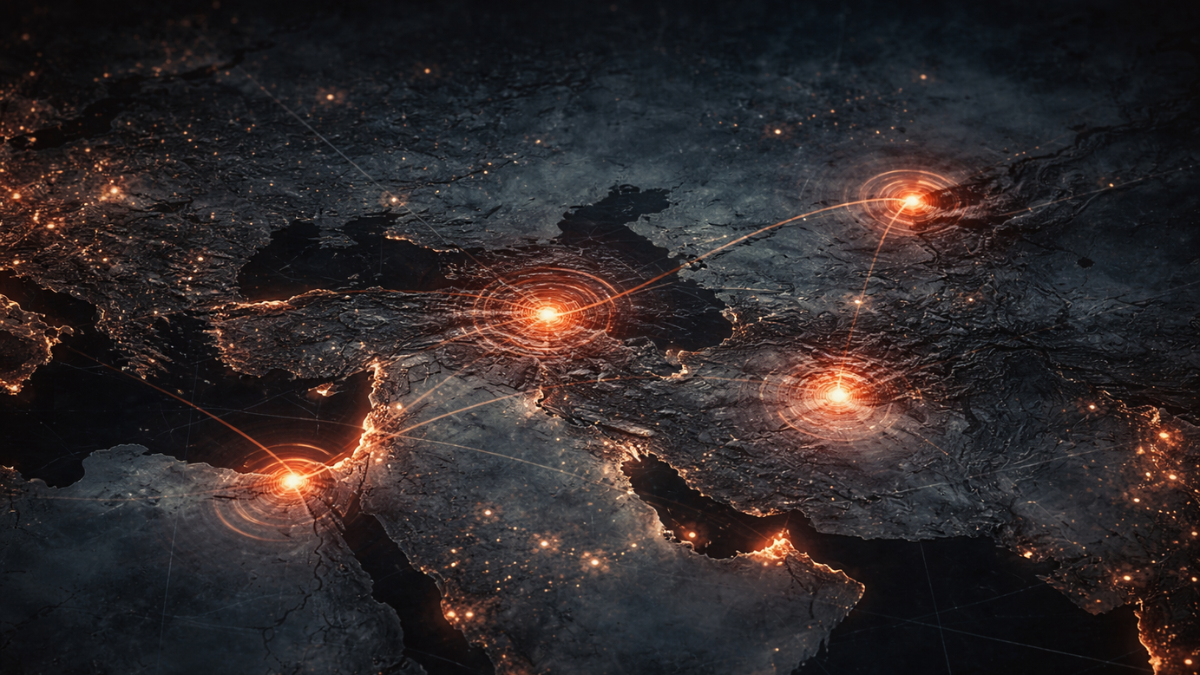


The Middle East has seen a sharp rise in tensions over the past two weeks. What began as a direct conflict between Iran and Israel has now spread across several regions. The situation is no longer limited to one area. Instead, it now stretches from the Persian Gulf to the Caucasus and parts of the Eastern Mediterranean.
Reports confirm that several countries in the Persian Gulf have faced attacks. These include Jordan, Saudi Arabia, the United Arab Emirates, Bahrain, Kuwait, and Qatar. Many of these incidents targeted military and economic sites. These attacks are believed to be linked to ongoing strikes involving the United States and Israel.
At the same time, a different and unusual pattern has appeared. Explosions and military movements have been reported in places far from the main conflict zones. These include areas in Azerbaijan, especially the Nakhchivan region, parts of eastern Turkey, and locations near British military bases in Cyprus.
These incidents have raised serious questions. Many are asking who is responsible and why these areas are being affected. The timing and spread of these events have made the situation even more complex.
Mysterious Incidents and Fast-Blame Narratives
In Nakhchivan, explosions were reported near important infrastructure. Almost immediately, some media reports blamed Iran. These claims were made even before any detailed investigation took place.
Sanctions eased briefly to allow Iranian oil shipments already loaded to be sold
In eastern Turkey, a drone was shot down and a missile was intercepted. Officials first described the object as “unknown.” However, some international media outlets quickly suggested that Iran was behind the incident.
In Cyprus, there were reports of an explosion near a British military base in Akrotiri. Local authorities described it as part of military exercises. However, other sources suggested that a missile or debris may have struck the area.
What connects these three events is not just their timing. It is also the way the information was shared. In each case, accusations against Iran appeared very quickly. This happened before clear evidence was presented.
This pattern has drawn attention to the idea of “false flag operations.” This is a term used when an attack is carried out in a way that makes it look like another country is responsible. The goal is often to justify further action or change the direction of a conflict.
Strategic Interests and Expanding Conflict Zones
Looking at the situation closely, some analysts question whether it makes sense for Iran to expand the conflict into new areas. Opening new fronts in places like Azerbaijan or Turkey could increase pressure on Iran. It could also lead to a situation where Iran faces threats from multiple directions at the same time.
Global oil prices climb during Iran conflict, raising Saudi concerns
On the other hand, shifting the conflict to new regions could change the balance in the ongoing war. Recent strikes on American bases in Gulf countries have shown that key allies in the region may be vulnerable. This has caused concern among countries that have been working closely together on security.
Expanding the conflict to the north and west could bring new players into the situation. Azerbaijan, for example, has strong military and energy ties in its region. Any incident there could increase tensions along nearby borders.
Turkey is another key country. It has one of the largest armies in its alliance network. Any direct threat to its territory could lead to stronger involvement in the conflict. This could change the scale and nature of the situation.
Cyprus also holds strategic importance. The presence of British military bases and its position in the European region make it sensitive. Any incident there could draw in more international attention and response.
Across these regions, three common signs have been noted. First, there is the speed of accusations made after incidents. Second, the timing often matches important diplomatic developments. Third, certain outcomes may benefit specific parties if the conflict spreads further.
These patterns have made the situation more difficult to understand. The mix of military action, media reports, and political reactions has created a complex picture. As events continue to unfold, the spread of incidents across different regions remains a key point of concern.