

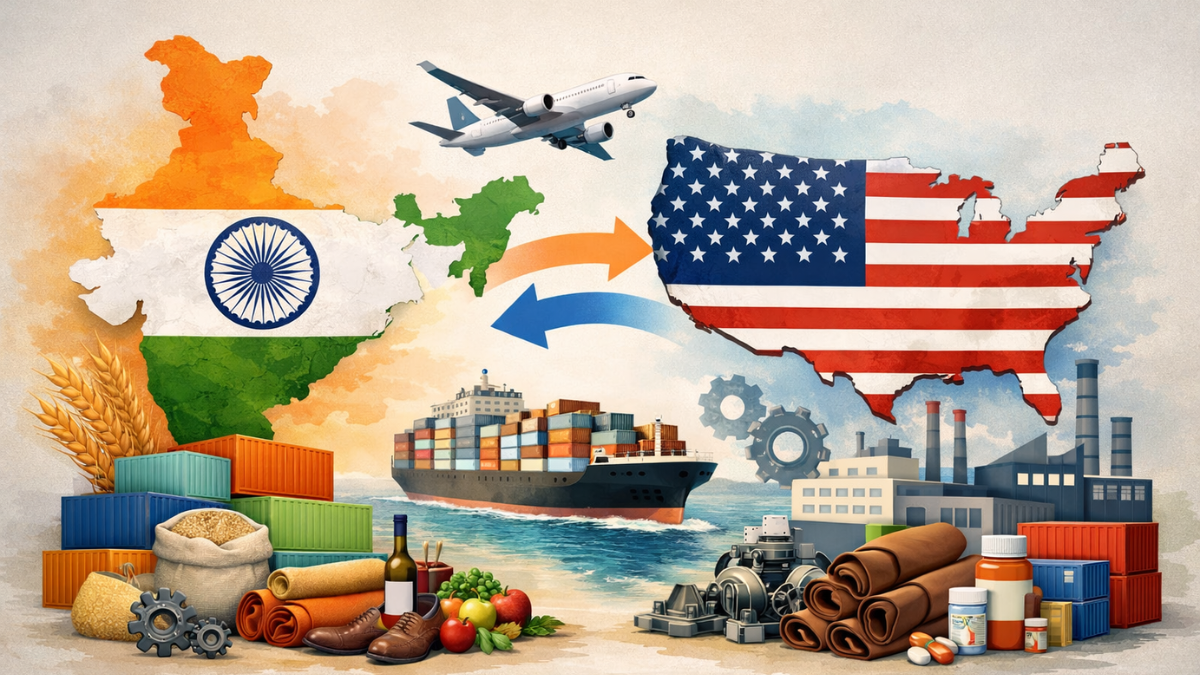


India and the United States have introduced an interim trade framework that reshapes how goods will be traded between the two countries. The announcement marks an important step toward a larger Bilateral Trade Agreement (BTA), which is still under negotiation. The temporary framework focuses on balancing trade while allowing both countries to expand business opportunities across multiple sectors.
The announcement gained attention after it was first shared through Truth Social by Donald Trump and later confirmed by Prime Minister Narendra Modi through the social media platform X. While the earlier updates did not include full details, the newly revealed framework clearly outlines tariff changes and trade commitments affecting several key industries.
Interim Trade Framework and Key Commitments
The interim trade agreement aims to increase trade cooperation between India and the United States. Under this framework, India has agreed to lower or completely remove tariffs on several American goods. These include agricultural and food-related items such as dried distillers’ grains, red sorghum used for animal feed, tree nuts, fresh and processed fruits, soybean oil, wine, spirits, and other industrial products.
In return, the United States will reduce reciprocal tariffs on Indian goods to 18%. This change is considered important because India previously faced a combined tariff rate of nearly 50%. The earlier tariff included a 25% reciprocal duty along with an additional 25% penalty related to India’s purchase of Russian oil.
India’s exporters face fresh setback as Mexico raises tariffs on non-FTA nations
The framework also highlights commitments to improve supply chains and expand market access between both countries. The agreement is expected to help businesses in both nations trade goods more easily while creating stronger economic ties. The interim deal serves as a stepping stone before the final Bilateral Trade Agreement is completed, which is expected to include more detailed trade policies and wider product coverage.
Full List of Indian Export Items Facing 18% Reciprocal Tariffs
The United States will apply an 18% tariff rate on several Indian goods classified as originating from India. One of the biggest sectors affected is textile and apparel. This includes garments, fabrics, ready-made clothing, and other textile products, which are among India’s largest export industries.
The leather and footwear sector will also be included under the 18% tariff rate. This covers leather accessories, shoes, handbags, belts, and other leather-based fashion products manufactured in India. These products are widely exported and support a large workforce in India’s manufacturing sector.
Plastic and rubber goods will also fall under the new tariff rate. These products include industrial plastic items, packaging materials, rubber components, and various manufacturing supplies used across industries. Organic chemicals exported from India will also face the same tariff. These chemicals are widely used in industries such as pharmaceuticals, agriculture, and manufacturing.
The dog that didn’t bark”: U.S. Treasury chief Bessent concedes tariffs did not fuel inflation
Home décor products are another category included in the tariff list. These items include decorative handicrafts, furnishings, artistic decorations, and handmade home accessories. Artisanal products, which represent India’s traditional craft and handmade goods sector, are also part of the tariff structure.
Certain machinery products exported from India will also be taxed at 18%. These include selected industrial machines and mechanical equipment used in production processes. However, the tariff applies only to specific machinery categories and does not cover all industrial equipment.
Tariff Removal on Selected Goods and Global Rate Comparison
The interim trade agreement also provides relief for several Indian export sectors. According to the framework, reciprocal tariffs will be removed on products such as generic pharmaceuticals, gems and diamonds, and aircraft parts once the interim agreement is successfully finalized.
India and the United States seal major tariff deal after Modi–Trump talks, boosting Indian exports
India will also receive a preferential tariff rate quota for automotive parts. This provision is linked to trade rules under Proclamation 9888, which was introduced to adjust automobile and automobile part imports into the United States. Additionally, negotiations are ongoing under the Section 232 investigation regarding pharmaceutical ingredients and generic medicine exports from India.
In terms of global trade comparison, India’s new 18% tariff rate places it among countries with relatively lower tariff levels in Asia. Countries such as the European Union, Japan, and Switzerland face tariffs of around 15%, while the United Kingdom has a tariff rate close to 10%.
Several South and Southeast Asian countries have tariff levels similar to or slightly higher than India. Vietnam and Bangladesh face tariffs near 20%, while Pakistan, Malaysia, Cambodia, and Thailand have tariff rates of about 19%. Some countries continue to face significantly higher tariffs, including Brazil at around 50%, China at approximately 37%, Laos and Myanmar at nearly 40%, South Africa at about 30%, and South Korea at around 25%.
The interim India-US trade framework outlines key tariff adjustments across industries while negotiations for the broader Bilateral Trade Agreement continue.