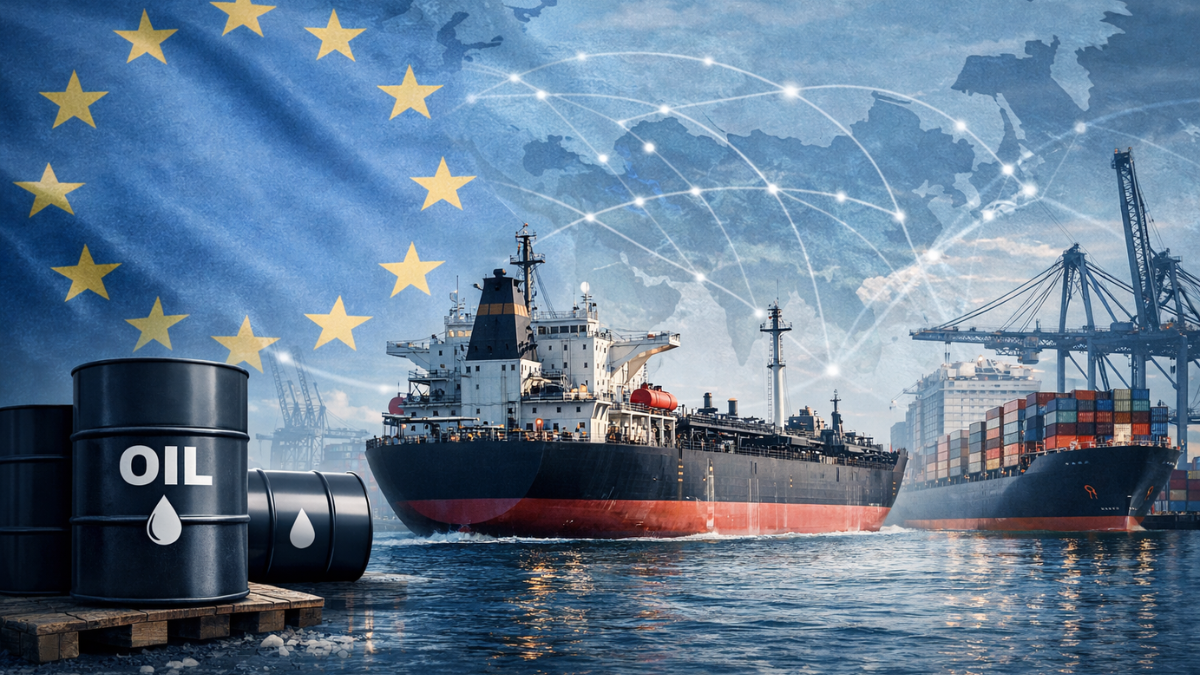


The European Union has approved a new round of sanctions aimed at cutting off financial and logistical support for Russian oil exports. Among those sanctioned is Murtaza Lakhani, a Canadian-Pakistani oil trader and chief executive of Mercantile & Maritime Group, a trading company with offices in Singapore and London.
The EU said that through companies under his control, Lakhani enabled the shipment and export of Russian oil, including oil linked to the state-owned company Rosneft.
These measures are part of the EU’s broader effort to limit revenue that helps fund Russia’s war in Ukraine. The decision was formally adopted and published in the EU’s Official Journal.
The sanctions target individuals and companies accused of helping Russia bypass Western restrictions on oil exports. Oil remains one of Russia’s most important income sources, and despite multiple sanctions packages, the country continues to sell large volumes of crude oil to global markets.
Oil trading networks and the shadow fleet
According to the EU, vessels controlled by companies linked to Lakhani transported crude oil or petroleum products originating in or exported from Russia. These activities allegedly helped Russia continue oil exports despite existing sanctions. Neither Lakhani nor Mercantile & Maritime Group responded to requests for comment following the announcement.
The EU said Russia has managed to adapt to sanctions by relying on a so-called shadow fleet of oil tankers. These vessels often operate outside the Western maritime system, using unclear ownership structures and non-Western insurance providers. This allows Russian oil to reach buyers in countries such as India and China, often at discounted prices.
The EU has now introduced 19 sanctions packages since the start of the Ukraine war. More than 2,600 individuals and entities are currently listed. In the latest measures, the EU targeted nine individuals and entities connected to Russia’s shadow fleet of oil tankers. Officials also said more than 40 additional ships are expected to be added soon, bringing the total number of sanctioned vessels to about 600.
These sanctions prohibit EU citizens and companies from doing business with listed individuals and entities. They also restrict access to shipping services, insurance, and financial support, making oil trading more difficult and costly.
Background of key figures and companies
Murtaza Lakhani has worked in the global oil industry for decades. Earlier in his career, he worked at Glencore, where he was involved in Iraqi oil exports. He later moved to Iraq’s Kurdistan region, where he acted as an intermediary in oil sales conducted independently of Iraq’s central government in Baghdad.
During this period, Russian energy company Rosneft signed oil and gas agreements in Kurdistan. Lakhani worked closely with Rosneft chief executive Igor Sechin, including during public signing ceremonies at Russia’s main economic forum in St Petersburg. He later partnered with global oil trader Vitol to invest in a minority stake in Vostok Oil, Rosneft’s major Arctic oil project.
The EU also sanctioned Valery Kildiyarov, a director at Litasco Middle East DMCC, a trading subsidiary linked to Lukoil, and a manager at another Lukoil-connected firm, Alghaf Marine, based in Dubai.
Additionally, Etibar Eyyub, Anar Madatli, and Talat Safarov were listed due to their ties to Coral Energy, later renamed 2Rivers Group. Coral Energy became one of the largest traders of Russian oil. After a management buyout and name change in 2024, the company said it largely stopped Russian oil trading in 2023 and exited its final contract in early 2024. Following UK and EU sanctions, it said trading activities ended in June and the business was dissolved in August.
Russia’s Permanent Mission to the EU said the new sanctions would be ineffective and would harm EU citizens by increasing economic pressure within Europe.