

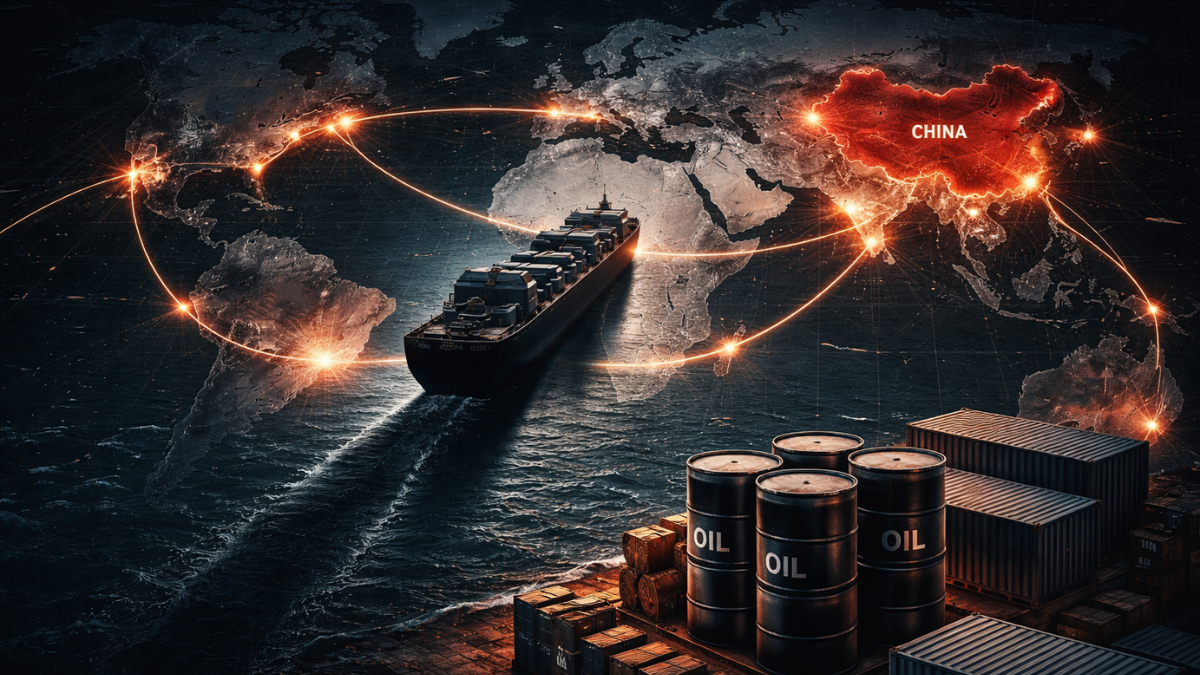


A key committee in the United States has called for a strong crackdown on China’s alleged imports of oil from countries facing international sanctions. The panel, formed to study strategic competition with China, released a detailed report highlighting what it sees as serious gaps in how these sanctions are being enforced.
The recommendations come under the administration of Donald Trump, as lawmakers urge stronger action to address the issue. According to the report, China has significantly increased its imports of oil from countries like Russia, Iran, and Venezuela. These countries are under various sanctions imposed by Western nations. The committee believes that instead of limiting these countries’ oil revenues, the sanctions have unintentionally allowed China to buy oil at heavily discounted prices.
Data cited in the report shows that in 2025, China imported around 2.6 million barrels of sanctioned oil per day. This accounts for nearly one-quarter of its total seaborne oil imports. The report argues that this growing trade has concentrated cheap oil supplies in China’s hands, giving it an economic advantage.
The committee warned that current enforcement systems are not strong enough. It stressed that these gaps must be closed to ensure sanctions work as intended.
Proposed Measures to Tighten Enforcement
The report outlines several steps that the US government could take to address the issue. One major suggestion is to blacklist port operators and shipping companies that are involved in handling sanctioned oil. This would make it harder for such oil to be transported and traded globally.
Houthis issue warning over Red Sea use as US–Israel tensions with Iran grow
Another key recommendation is to target the complex financial networks used in these transactions. These include currency exchange houses and proxy accounts that help move money without drawing attention. The committee also proposed creating a whistleblower reward system to encourage people to report such activities.
The report also raised concerns about “shadow fleets.” These are ships that try to avoid detection by turning off or manipulating their tracking systems. The committee suggested expanding the US Coast Guard’s cyber capabilities to better identify and track these vessels.
In addition, the panel called for an investigation into foreign refineries that regularly purchase discounted Russian oil. It suggested that such practices could amount to market manipulation, as they may artificially lower global oil prices. This, in turn, could put US refineries at a disadvantage.
To address pricing concerns, the committee advised coordinating with major oil-producing nations. It recommended that the US work with members of the Organisation of the Petroleum Exporting Countries and its allies to increase oil production once conditions stabilize in key regions like the Strait of Hormuz.
Venezuela’s gold and mineral sector reopens as US lifts economic restrictions
China’s Response and Broader Context
China has strongly denied the allegations made in the report. Liu Pengyu, spokesperson for the Chinese embassy in the United States, stated that the country opposes unilateral sanctions that are not approved by the United Nations. He argued that such measures lack a proper legal basis and should not interfere with normal trade activities.
China also emphasized that its energy cooperation with other countries is legitimate and does not target any third party. It stated that it will continue to protect its energy security and the rights of its businesses and citizens.
The situation is further complicated by recent global developments. Due to rising tensions and supply concerns linked to conflict involving Iran, the United States has temporarily eased some restrictions on Russian and Iranian oil. This step was taken to help stabilize global oil prices and avoid shortages.
Despite this easing, the committee’s report highlights a push for stricter enforcement in the long term. The global energy market remains complex, and any major changes could have wide-ranging effects.
The report also pointed out that over-the-counter oil transactions may be affecting global benchmark prices. This could create an uneven playing field, especially for companies that strictly follow sanctions.
Overall, the issue reflects ongoing tensions in global energy trade. It shows how sanctions, pricing, and international relations are closely connected, and how actions in one area can influence markets and policies worldwide.