

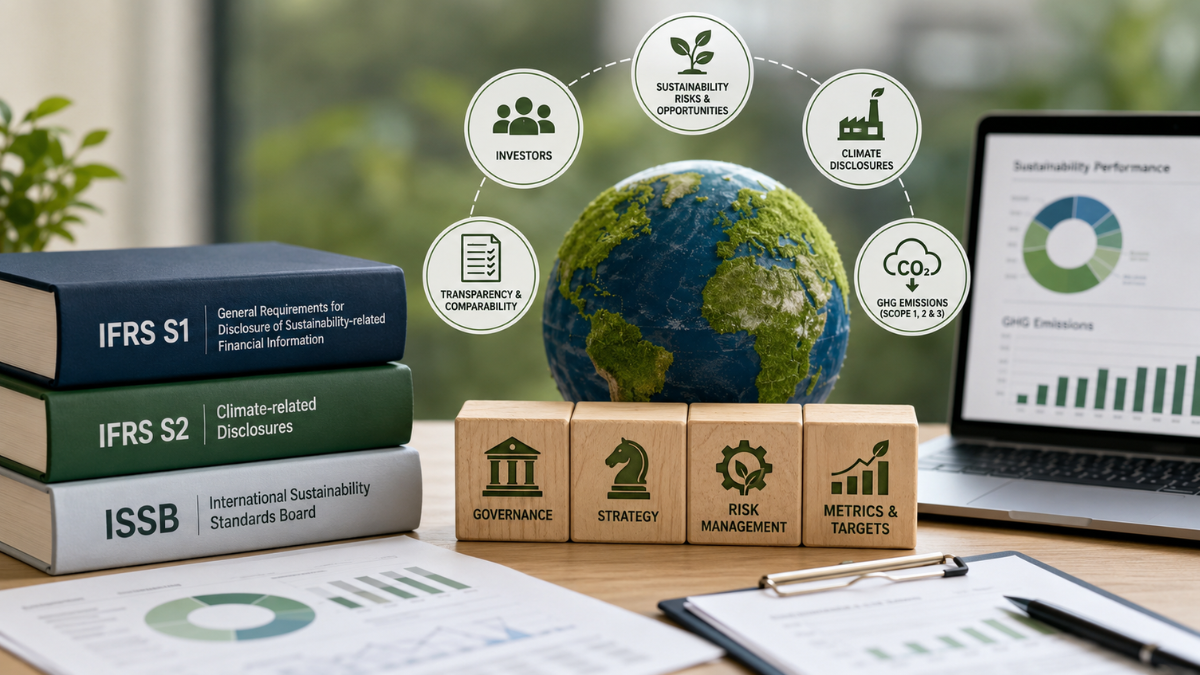


The International Sustainability Standards Board (ISSB) has introduced a global baseline for sustainability reporting. Its standards help companies disclose sustainability-related information in a consistent and comparable way for investors and capital markets. Instead of using several different reporting frameworks, businesses can follow a common reporting structure that improves transparency and supports better financial decision-making.
Many companies already report under frameworks such as the Corporate Sustainability Reporting Directive (CSRD), the Global Reporting Initiative (GRI), and earlier climate disclosure frameworks. The ISSB standards are designed to fit into this evolving reporting landscape while focusing on sustainability information that may affect a company’s financial performance.
Summary
-
ISSB was established by the IFRS Foundation in November 2021.
-
It provides a global baseline for sustainability-related financial disclosures.
-
IFRS S1 covers general sustainability-related financial information.
-
IFRS S2 focuses on climate-related disclosures.
-
Both standards follow four reporting pillars.
-
IFRS S2 requires reporting of Scope 1, Scope 2, and Scope 3 emissions.
-
Countries decide whether to adopt or mandate the standards.
ISSB standards at a glance
Topic Requirement Established by IFRS Foundation Announced 3 November 2021 at COP26 in Glasgow First standards: IFRS S1 and IFRS S2 reporting pillars Governance, strategy, risk management, metrics and targets, materiality Single materiality focused on investors Climate reporting scope 1, scope 2, and scope 3 emissions using the GHG Protocol adoption are decided by individual jurisdictions.
Why the ISSB was created
Before the ISSB was introduced, companies often prepared sustainability reports using different voluntary frameworks. These included TCFD, SASB, the Climate Disclosure Standards Board (CDSB), the Value Reporting Foundation (VRF), and the Integrated Reporting Framework. As a result, many businesses had to prepare multiple reports covering similar information in different formats.
The ISSB was created to reduce this complexity. Rather than replacing previous work, it combined several well-known reporting initiatives into one global reporting baseline. TCFD, CDSB, and the VRF, which included SASB Standards and the Integrated Reporting Framework, became part of its reporting architecture.
The ISSB has four objectives:
-
Develop a global baseline for sustainability disclosures.
-
Meet the information needs of investors and capital markets.
-
Improve the quality and comparability of sustainability reporting.
-
Support interoperability with reporting requirements introduced by different jurisdictions.
What IFRS S1 requires
The ISSB published IFRS S1 in June 2023. This standard requires companies to disclose sustainability-related risks and opportunities that could reasonably affect cash flows, access to finance, or the cost of capital over the short, medium, and long term.
IFRS S1 uses four reporting pillars that are based on the former TCFD framework. Companies must explain how sustainability issues are governed, how they affect business strategy, how risks are identified and managed, and which metrics and targets are used to measure progress.
Where no ISSB standard exists for a sustainability topic, IFRS S1 requires companies to refer to SASB Standards for industry-specific guidance. This allows existing SASB metrics to remain part of the reporting process.
What IFRS S2 requires
IFRS S2 was also published in June 2023 and focuses entirely on climate-related disclosures. It follows the same four reporting pillars as IFRS S1 while fully incorporating the recommendations that were previously covered under TCFD.
Companies applying IFRS S2 must disclose physical and transition climate risks, climate-related opportunities, climate scenario analysis, and any climate transition plans together with related targets and milestones.
EPA drops lives saved from pollution math, putting business costs ahead of public health
The standard also requires disclosure of absolute gross Scope 1, Scope 2, and Scope 3 greenhouse gas emissions using the GHG Protocol Corporate Standard. Scope 3 reporting covers all 15 recognized categories under the GHG Protocol.
For first-time reporters, IFRS S2 includes a climate-first relief option. This allows companies to begin with climate disclosures before fully complying with all IFRS S1 requirements.
Key climate disclosure requirements
-
Physical and transition climate risks.
-
Climate-related opportunities.
-
Climate scenario analysis.
-
Scope 1, Scope 2, and Scope 3 emissions.
-
Climate transition plans where available.
-
Climate targets and milestones.
How ISSB works with other reporting frameworks
The ISSB standards are designed to work alongside existing reporting frameworks rather than replace all of them.
-
TCFD: IFRS S2 fully incorporates the TCFD recommendations. Companies applying IFRS S2 do not need a separate TCFD report.
-
SASB Standards: IFRS S1 refers companies to SASB Standards when no ISSB guidance exists for a topic.
-
GHG Protocol: IFRS S2 uses the GHG Protocol Corporate Standard for emissions reporting.
-
CSRD and ESRS: ISSB uses single materiality, while CSRD follows double materiality. The two systems have been developed to improve interoperability.
-
GRI: GRI focuses on a broader stakeholder audience, while ISSB focuses on investors and capital markets.
Materiality, reporting scope, and disclosure requirements
IFRS S1 uses a single materiality approach. Information is considered material if leaving it out, misstating it, or obscuring it could reasonably influence investor decisions. Companies must also explain the judgements used during the materiality assessment.
The standards require companies to consider sustainability risks and opportunities across their entire value chain. This includes upstream suppliers and downstream customers where those activities could affect the company’s financial position.
The Hidden Struggle of Cross-Border ESG Compliance
IFRS S2 requires companies to report Scope 1, Scope 2, and Scope 3 greenhouse gas emissions. Scope 3 includes emissions from purchased goods and services, capital goods, transportation, use of sold products, investments, and other recognized categories under the GHG Protocol.
A one-year relief period is available for Scope 3 reporting during the first year of applying IFRS S2. Where complete quantitative information is not yet available, companies may provide qualitative disclosures, provided they explain the temporary use of this relief and indicate when quantitative reporting will become available.
The standards also include proportionality provisions. Businesses that cannot immediately provide complete quantitative information may temporarily use qualitative disclosures. These relief measures are transitional and are not permanent exemptions.
Where the ISSB standards apply
The ISSB standards are not automatically mandatory across the world. Instead, they provide a global reporting baseline that individual countries may adopt, adapt, or make mandatory through their own legal and regulatory systems.
Several jurisdictions, including Australia, Canada, Japan, Singapore, and the United Kingdom, have already moved towards mandatory adoption or alignment. The EU’s CSRD and the US climate disclosure rules are also based on closely related reporting concepts.
For companies operating across multiple countries, reporting obligations depend on how each jurisdiction has implemented or aligned with the ISSB standards alongside its own sustainability reporting requirements.