



Summary
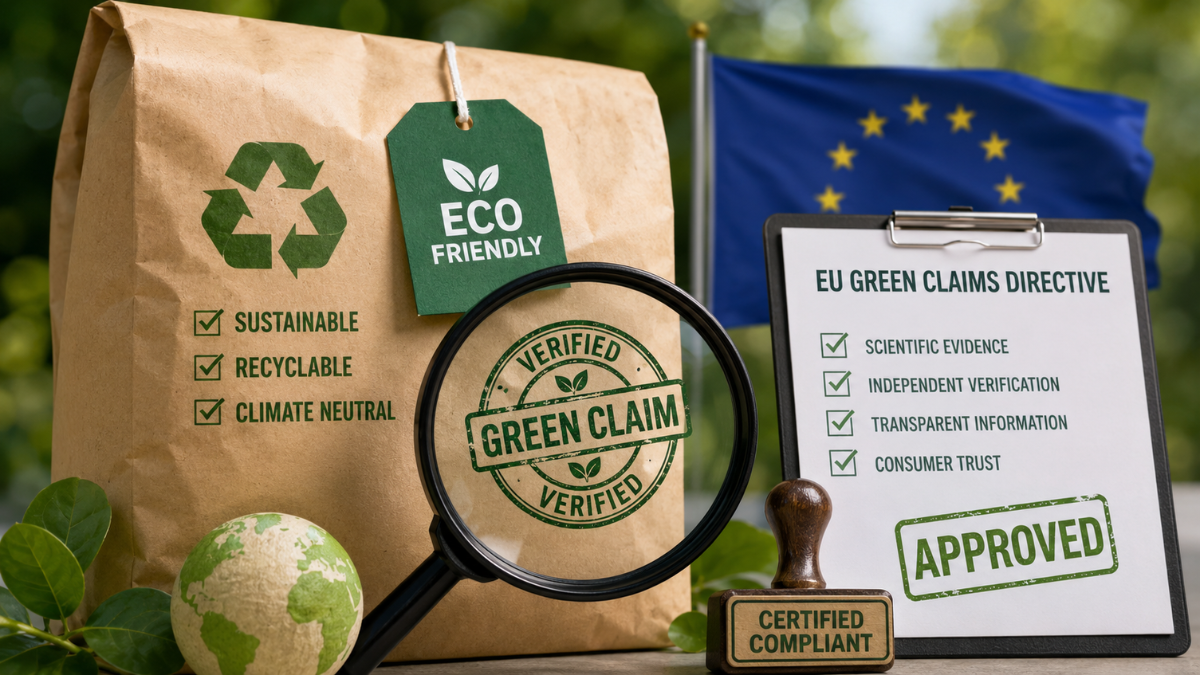
The proposed EU Green Claims Directive is designed to prevent greenwashing by ensuring that environmental claims made by businesses are backed by scientific evidence and independently verified before reaching consumers. As the European Union moves to tighten rules on environmental marketing, manufacturers selling products in the EU will soon face stricter requirements for making sustainability claims.
The draft directive was adopted by the European Parliament in March 2024 and is currently in the trilogue negotiation phase. If adopted, EU member states are expected to receive two years to incorporate the rules into national law, with the new requirements likely becoming applicable in 2027.
The Green Claims Directive aims to stop misleading environmental advertising
Many manufacturers today promote products using terms such as “sustainable,” “recyclable,” “climate neutral,” or statements like “packaging made from 30% recycled plastic.” Others advertise reductions in carbon emissions by comparing current products with earlier years.
Until now, companies have generally not been required to prove many of these voluntary environmental claims before using them in advertisements or product information.
A study conducted by the European Union in 2020 found that many environmental claims were vague, misleading, or lacked proper evidence. This raised concerns that consumers could struggle to distinguish genuine sustainability efforts from marketing language.
The proposed Green Claims Directive seeks to address this issue by creating a common set of rules across the European Union. Its goal is to give consumers reliable information so they can make informed purchasing decisions while encouraging confidence in products that genuinely deliver environmental benefits.
The directive focuses on improving transparency rather than preventing companies from communicating sustainability efforts. Businesses making voluntary environmental claims will need to support those claims with clear evidence before presenting them to customers.
Key requirements under the proposed directive
- Environmental claims must be supported by scientific evidence.
- The rules apply to claims about products, services, or the company itself.
- Claims covered are voluntary environmental statements not already regulated by other EU laws.
- Independent accredited verification bodies must examine claims before they are published.
- Companies can only use approved environmental claims after receiving a certificate of conformity.
- The certificate will be recognised across all EU member states.
- Rules also apply to environmental labels to improve their reliability.
Which manufacturers are covered and how the verification system works
The proposed Green Claims Directive mainly applies to business-to-consumer (B2C) transactions. This means businesses selling products or services directly to consumers in the European Union will be covered by the new requirements.
In principle, the directive applies to companies operating in the EU regardless of their size. Small and medium-sized enterprises are also included, although the draft provides certain exemptions or simplified requirements for these businesses.
One of the biggest changes introduced by the proposal is the requirement for independent verification before environmental claims can be published. Rather than allowing businesses to make claims first and justify them later, companies will need approval in advance.
Accredited testing bodies will assess whether the environmental claim is supported by scientific evidence and meets the legal standards laid down in the directive. Only after successful verification will businesses receive a certificate confirming compliance.
This certificate will allow companies to use the approved environmental claim throughout the European Union, creating a common approach across member states.
The proposal also introduces rules covering environmental labels, often referred to as ecolabels. These measures aim to ensure that labels displayed on products provide reliable information instead of creating confusion for consumers.
⏳ A Ticking Time Bomb in the Wind Industry—Blade Cracks That Could Cost the Climate Fight
The European Commission first presented the proposal in March 2023. The European Parliament adopted the draft at its first reading in March 2024. The Council later adopted its general approach in June 2024, and trilogue negotiations between the Parliament, Council and Commission began in January 2025.
If the legislative process is completed, member states are expected to receive around two years to implement the directive into national law before the rules become binding approximately one year later.
The proposed directive provides for penalties when companies fail to comply with its requirements. Individual EU member states will determine the exact nature and level of fines after implementing the legislation into their national legal systems.
Authorities may consider several factors when determining penalties. These include the seriousness of the infringement, whether the violation was intentional, whether similar offences have occurred repeatedly, and any financial benefit gained by the company.
Apart from financial penalties, businesses also face reputational risks. Proceedings involving misleading environmental claims are often reported publicly, which can affect consumer trust and brand image.
The proposal also allows consumers, environmental organisations, nature protection groups, consumer protection organisations, and competing businesses to report suspected unauthorised environmental claims to the relevant authorities.
Existing EU rules on environmental advertising
Environmental advertising is also addressed through another EU measure known as the EmpCo Directive, formally titled the directive on empowering consumers for the green transition through better protection against unfair practices and better information.
The EmpCo Directive was published on 6 March 2024 as part of the European Green Deal. EU member states must implement its requirements by 27 September 2026. In Germany, these rules will be incorporated into the national law governing unfair competition.
The EmpCo Directive directly prohibits certain environmental advertising practices. One example is advertising climate neutrality when that claim relies only on carbon offsetting measures. Compared with these broader rules, the Green Claims Directive serves as the more specific legislation governing environmental claims.
Filming Controversy: Breach of Protected Area Rules
Even before the Green Claims Directive becomes law, businesses are already expected to avoid misleading environmental advertising. Existing court decisions have established strict standards for such claims.
A ruling issued on 27 June 2024 found that advertising claiming climate neutrality can be considered misleading if it does not clearly explain whether climate neutrality is achieved through actual carbon dioxide reductions or through offsetting measures.
Some companies have responded to increasing scrutiny by reducing communication about their sustainability initiatives, a practice referred to as green hushing. This involves remaining silent about environmental measures despite implementing them. Studies mentioned alongside the proposal note that sustainability measures can increase both company value and brand value, although the directive itself focuses on ensuring that any environmental claims made are accurate, transparent and supported by evidence.