

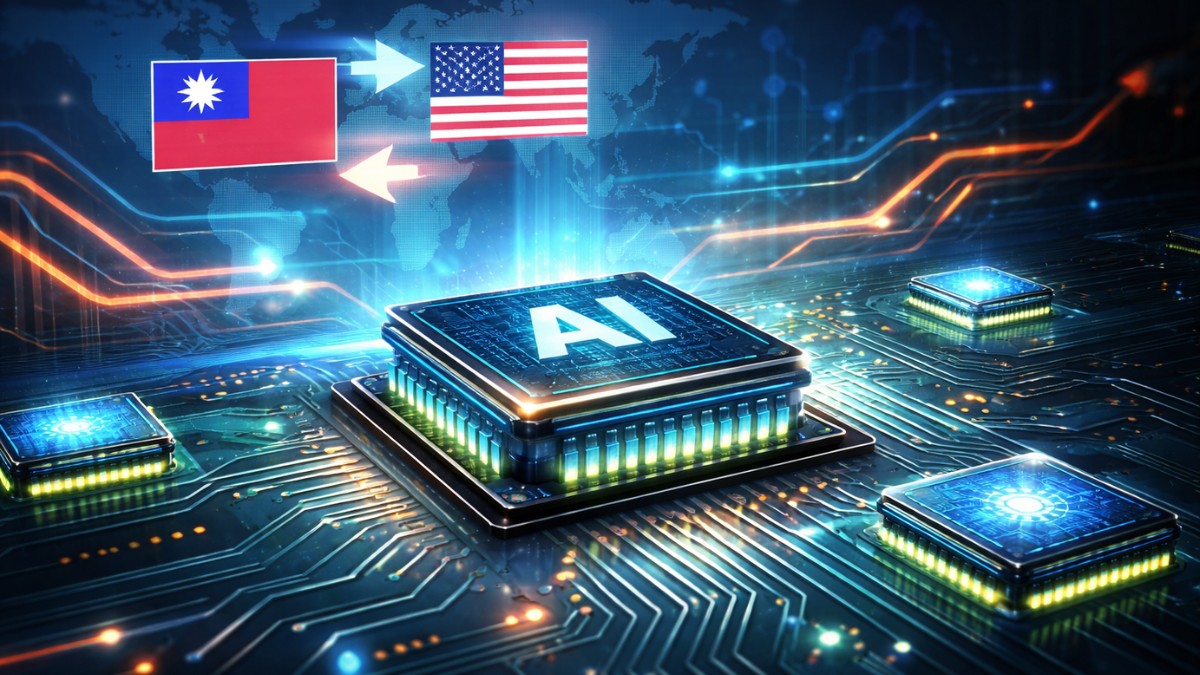


Taiwan has vowed to stay at the top of the world in AI chip production after signing a new trade deal with the United States. The agreement lowers tariffs on Taiwanese goods, encourages massive investment in American chip factories, and reshapes the global semiconductor market. With China watching closely, this deal highlights Taiwan’s crucial role in powering technology around the world.
New US Trade Deal Reduces Tariffs and Boosts Investment
Under the agreement, the United States will cut tariffs on Taiwanese goods to 15 percent, down from the previous 20 percent. Certain products, such as auto parts, timber, and lumber, will have a cap at 15 percent. Other goods like generic medicines and some natural resources will face no tariffs.
Taiwan’s government confirmed that the new tariff rates will not be added on top of existing duties, a relief for local industries that worried about higher costs. Taiwanese Premier Cho Jung-tai praised negotiators for what he called a “well-executed home run,” highlighting the effort that went into reaching the deal.
The agreement also includes significant investment commitments. Taiwanese companies are expected to put at least $250 billion into building and expanding semiconductor and AI chip production in the United States. Taiwan itself will provide credit guarantees of another $250 billion to encourage companies to invest. These steps aim to strengthen the US semiconductor supply chain, according to US Commerce Secretary Howard Lutnick.
America trades tariffs for chips as Taiwan commits hundreds of billions to US factories
Industry experts in Taiwan welcomed the lower tariff rate. Chris Wu, sales director at Taiwanese machine tool maker Litz Hitech Corp, said the tariff reduction was positive, putting Taiwan on par with competitors like South Korea and Japan. However, he noted that single-digit profit margins make it hard to absorb high tariffs for US customers.
Taiwan’s Chip Leadership Remains Strong
Taiwan produces more than half of the semiconductors exported to the US. The island has been described as a “silicon shield” because of its crucial role in the global technology supply chain. Taiwan’s dominance in chip production is seen as a factor that discourages military aggression from China, which claims Taiwan as part of its territory.
The government said that Taiwan will remain the world’s top producer of AI semiconductors for both local and global markets. Advanced chip production will be split between Taiwan and the US, with roughly 85 percent in Taiwan and 15 percent in the US by 2030, adjusting to 80-20 by 2036, according to Economic Affairs Minister Kung Ming-hsin.
If America can do this, why can’t China?” — Maduro raid ignites Taiwan fears on Chinese social media
The trade deal is expected to reshore a significant part of the US semiconductor industry, meaning more production will happen in America. This effort is part of a global push to reduce risks if supply chains are disrupted by geopolitical tensions.
Reactions and Impact on the Industry
The trade deal has drawn mixed reactions in Taiwan. Some lawmakers, including Cheng Li-wun, chairperson of the Kuomintang party, expressed concern that sending part of the production to the US could weaken Taiwan’s economy. Others saw the deal as a positive step for global trade, as it lowers costs and strengthens ties with a major trading partner.
The agreement also has implications for major chip companies. TSMC (Taiwan Semiconductor Manufacturing Company), the world’s largest contract chipmaker, has plans to expand operations in the US. Land has already been purchased in Arizona, signaling potential growth of AI chip production there.
The agreement also allows Taiwanese producers investing in the US to receive favorable treatment for future semiconductor duties, supporting continued investment and ensuring a strong supply of AI chips.
China has criticized the agreement and expressed strong opposition, signaling tensions in the region. The deal is still pending approval by Taiwan’s parliament, where discussions about economic and political risks are ongoing.