

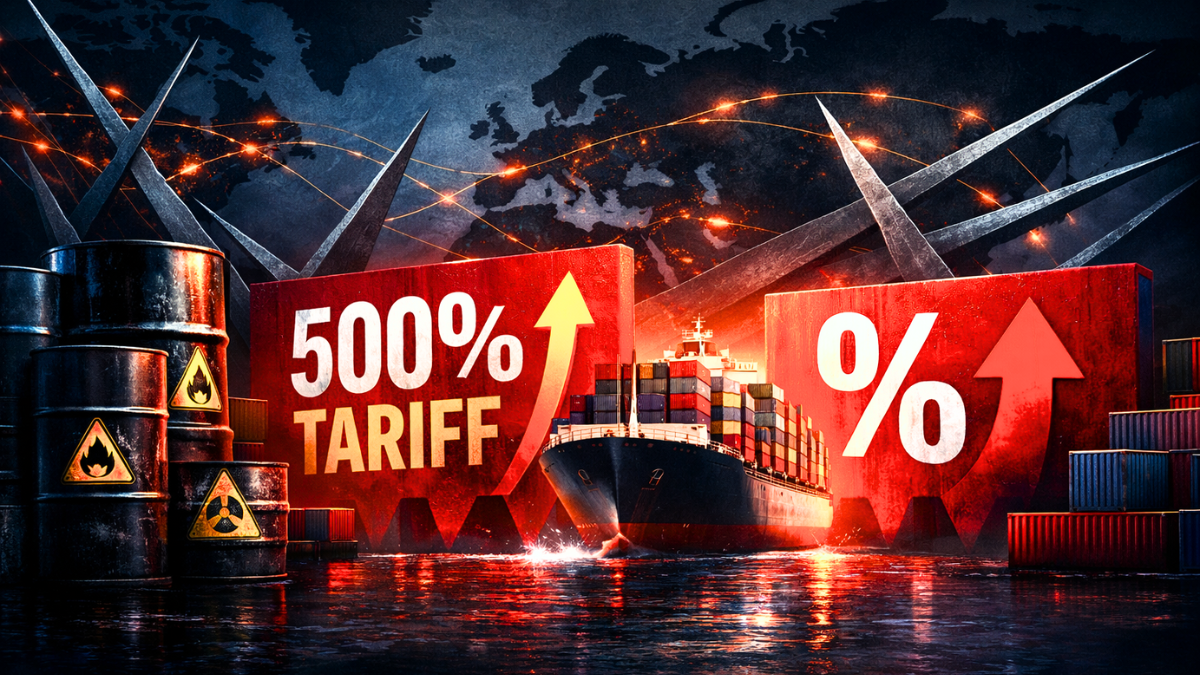


The United States has approved a new sanctions law that could significantly impact global trade. President Donald Trump has cleared the Sanctioning Russia Act of 2025, a bill that allows the U.S. to impose massive tariffs on countries that continue to buy Russian oil and uranium. Under the law, tariffs on goods and services imported into the United States from such countries could rise to at least 500%.
The bill is aimed at increasing pressure on Russia over the ongoing war in Ukraine. U.S. officials argue that Russia earns large revenues from discounted oil sales, which help fund its military operations. The legislation targets countries that “knowingly engage” in the trade of Russian-origin petroleum products or uranium, warning of severe economic consequences.
What the Russia Sanctions Bill Includes
The Sanctioning Russia Act of 2025 gives the U.S. President authority to sharply increase import duties on countries that continue energy trade with Russia. The bill states that the rate of duty on all goods and services imported into the U.S. from such countries must be raised to no less than 500% of their value.
The sanctions are directly linked to Russia’s actions in Ukraine. The law allows these measures to be triggered if the Russian government, or any person acting on its behalf, refuses to negotiate a peace agreement. The penalties may also apply if a peace deal is violated, if another invasion of Ukraine occurs, or if efforts are made to overthrow, dismantle, or weaken the Ukrainian government.
Telegram faces fallout from Russia sanctions as $500 million in bonds remain frozen
U.S. Senator Lindsey Graham, who worked on the bipartisan bill, said the goal is to punish countries that buy cheap Russian oil. He stated that such trade helps finance Russia’s war effort. According to him, the bill gives the U.S. President strong leverage over countries whose energy purchases indirectly support the conflict.
Countries Facing Direct Trade Pressure
Several major economies could be affected by the sanctions if they continue importing Russian energy. The bill makes clear that any country found to be knowingly engaging in trade involving Russian oil or uranium could face the same penalties.
China is among the countries most exposed due to its large imports of Russian energy products. If the bill is enforced fully, Chinese exports to the United States could become far more expensive, making trade more difficult.
India has also faced earlier trade action over Russian oil purchases. In August 2025, the United States imposed additional tariffs on certain goods, arguing that the energy trade indirectly supported Russia’s war effort. Indian officials later stated that purchases of Russian oil had been reduced and sought relief from the added duties.
Cargo ship carrying banned Russian steel seized amid probe into Baltic telecom cable damage
President Trump has repeatedly warned that tariffs could be increased further if countries do not cooperate on reducing Russian energy imports.
Diplomatic Context and Ongoing Tensions
President Trump has acknowledged that the tariffs linked to Russian oil have strained trade relations with some countries. He has publicly said that certain partners were unhappy with the trade measures but noted that reductions in Russian oil imports had taken place.
At the same time, Trump has positioned himself as a possible mediator in the Russia–Ukraine conflict. He has held discussions with Russian President Vladimir Putin and Ukrainian President Volodymyr Zelenskyy, though no concrete peace agreement has been announced.
The sanctions bill also includes provisions allowing the U.S. President to revoke or reapply measures based on developments in the conflict. If Russia violates any negotiated peace agreement or escalates military action, the sanctions can remain in place or be reinforced.
As the bill moves toward wider bipartisan approval, it adds pressure on countries involved in Russian energy trade. The legislation ties global trade consequences directly to the course of the Ukraine war, increasing uncertainty for international markets and diplomatic relations.