

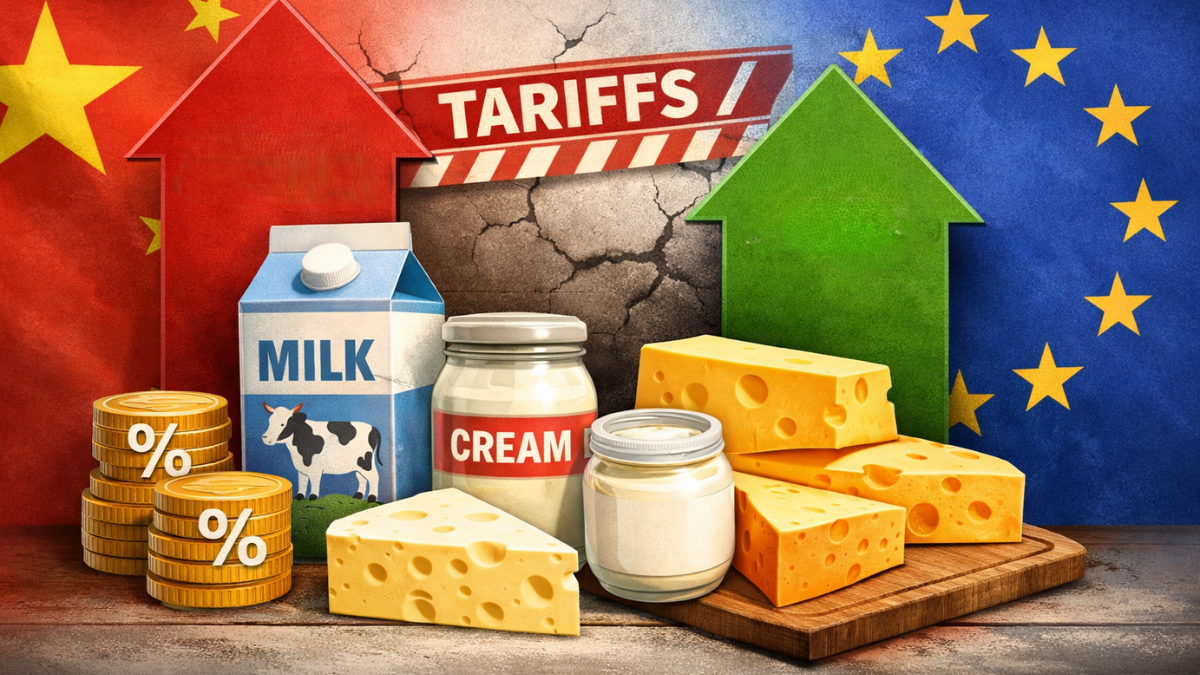


China has announced new tariffs on dairy products imported from the European Union, escalating trade tensions between the two sides. The move follows an anti-subsidy investigation launched in August 2024 and targets a wide range of European dairy exports.
The decision was formally announced by China’s Ministry of Commerce, which stated that subsidies provided by the European Union had caused serious harm to China’s domestic dairy industry. The tariffs are among the highest China has imposed on EU food products in recent years and are expected to significantly affect trade between China and Europe.
China imposes steep tariffs after anti-subsidy probe
The Ministry of Commerce confirmed that tariffs ranging from 21.9% to 42.7% will be applied to EU dairy imports. According to the ministry, the investigation found that EU subsidies allowed European dairy products to be sold in China at unfair prices. These practices caused “substantial damage” to local producers, including businesses involved in milk processing, cheese production, and cream supplies.
The tariffs are calculated based on what China calls “ad valorem subsidy rates.” These rates depend on the level of financial support provided to European producers. Products with higher subsidy levels face higher tariffs.
The ministry said the tariffs will take effect on December 23, while final rates will be determined by the Customs Tariff Commission. Companies that cooperated with China’s investigation will face a tariff of 28.6%, while companies that did not cooperate will be charged the maximum rate of 42.7%.
Concerns grow over paid anti-China content appearing as public opinion in Japan
The measures cover a range of dairy products, including fresh cheese, processed cheese, and certain types of milk and cream. These products are widely exported from the EU and are used by manufacturers, retailers, and households across China.
Dairy tariffs follow previous actions on pork and brandy
The dairy tariffs come shortly after China adjusted duties on other European food imports, showing a broader pattern of trade enforcement. Last week, China cut tariffs on pork imports and pig by-products from the EU, with new rates ranging from 4.9% to 19.8% on dozens of products.
Earlier, in September 2025, China imposed temporary anti-dumping tariffs of up to 62.4% in the form of cash deposits on EU pork imports. These measures made European pork more expensive in the Chinese market and were part of a targeted approach to protect domestic producers.
China has also taken action against EU brandy imports. In November 2025, the EU challenged these tariffs at the World Trade Organisation (WTO), stating that China’s provisional measures on brandy were inconsistent with WTO rules.
European Commission delays Mercosur trade deal after Italy seeks assurances for farmers
These steps have affected major European export sectors, particularly agriculture and food processing, highlighting the sensitivity of these industries in the ongoing trade dispute.
Trade tensions escalate after EU tariffs on Chinese electric vehicles
The dairy tariffs are part of a wider trade conflict that intensified after the European Commission imposed tariffs of up to 45% on Chinese electric vehicles in October 2024. The EU said Chinese EV producers benefited from heavy government subsidies, allowing them to sell vehicles at lower prices and hurting European manufacturers.
China strongly opposed this decision and has since implemented several retaliatory trade actions targeting EU exports. The Ministry of Commerce said the dairy tariffs are based on a formal anti-subsidy investigation, linking EU subsidies directly to harm in China’s dairy sector.
As of now, the tariffs cover specific dairy products and exporters. However, they are part of a growing list of trade measures exchanged between China and the EU in recent months. The measures underline the ongoing strain in EU-China trade relations, with agriculture, food products, and industrial goods increasingly central to the disputes between the two sides.