

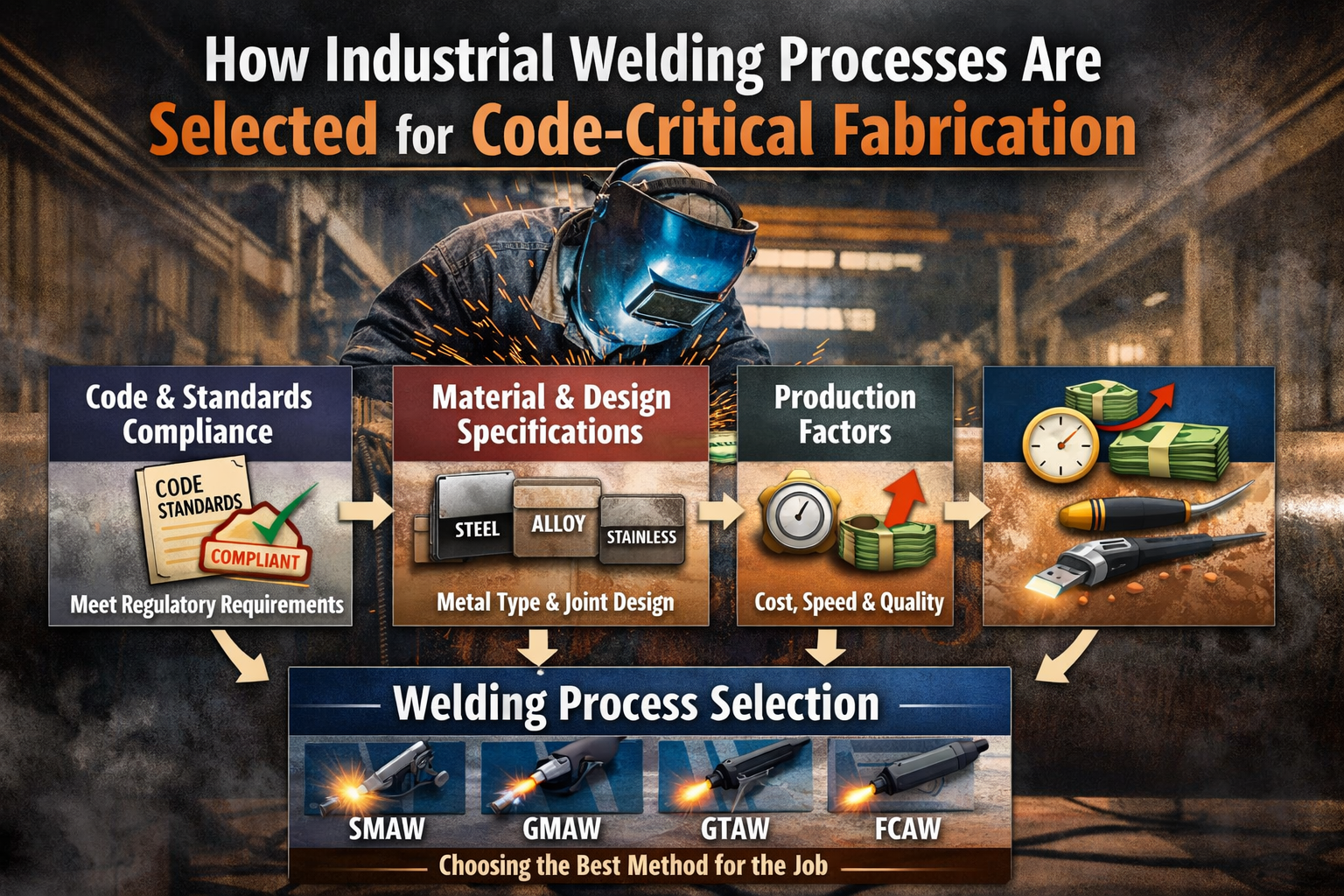


How Industrial Welding Processes Are Selected for Code-Critical Fabrication
In heavy industry, welding is not simply a method of joining metal — it is a critical engineering decision that directly affects structural integrity, pressure containment, corrosion resistance, and long-term performance. From pressure vessels and storage tanks to structural steel and complex assemblies, selecting the right welding process is essential for meeting code requirements, safety standards, and operational expectations.
Yet, outside of fabrication and engineering circles, welding is often viewed as a single skill rather than a family of specialized processes, each with distinct strengths, limitations, and use cases. Understanding how welding teams make process decisions helps explain why qualified fabrication partners place so much emphasis on procedure development, welder qualification, and inspection planning.
Why Welding Process Selection Matters in Industrial Fabrication
Industrial fabrication environments operate under a very different set of demands than light manufacturing or consumer applications. Welds may be subjected to:
-
High internal pressure
-
Cyclic loading and fatigue
-
Extreme temperatures
-
Corrosive or abrasive service conditions
-
Regulatory oversight from ASME, AWS, or other governing bodies
A welding process that performs well in one application may be entirely unsuitable in another. Poor process selection can lead to weld defects, costly rework, premature failure, or compliance issues during inspection.
For this reason, experienced fabricators evaluate welding processes not just for productivity, but for metallurgical compatibility, code compliance, and long-term reliability.
Common Industrial Welding Processes Used in Fabrication
Modern fabrication facilities rely on several proven welding processes, often using multiple methods within a single project. Each process offers specific advantages depending on material type, thickness, joint design, and code requirements.
Shielded Metal Arc Welding (SMAW)
Often referred to as “stick welding,” SMAW remains a staple in industrial environments due to its versatility and reliability.
Key advantages include:
-
Effective for thick materials
-
Performs well outdoors and in less-controlled environments
-
Widely accepted under industrial codes
SMAW is frequently used for structural steel, repair work, and field fabrication where environmental control is limited.
Gas Metal Arc Welding (GMAW)
Also known as MIG welding, GMAW is valued for its speed and consistency in controlled shop environments.
Benefits include:
-
High deposition rates
-
Clean welds with minimal slag
-
Efficient for long, continuous welds
In industrial fabrication, GMAW is often selected for production welding on carbon steel and stainless steel components where repeatability and throughput matter.
Flux-Cored Arc Welding (FCAW)
FCAW combines elements of SMAW and GMAW, offering excellent penetration and productivity.
Why fabricators choose FCAW:
-
High weld strength and deposition
-
Good performance on thicker materials
-
Suitable for structural and heavy plate applications
This process is commonly used in heavy industrial fabrication, particularly for large weldments and structural assemblies.
Gas Tungsten Arc Welding (GTAW)
Known as TIG welding, GTAW is selected when precision and weld quality are paramount.
Typical applications include:
-
Root passes on pressure vessels and piping
-
Stainless steel and specialty alloys
-
Thin materials requiring tight heat control
Although slower than other processes, GTAW produces exceptionally clean, high-integrity welds.
Submerged Arc Welding (SAW)
For large-scale industrial fabrication, SAW is often the process of choice for long, straight welds on thick plate.
Key characteristics:
-
Extremely high deposition rates
-
Deep penetration and consistent quality
-
Minimal arc exposure and spatter
SAW is widely used in pressure vessels, tanks, and heavy plate fabrication where productivity and weld integrity are both critical.
Code Requirements Drive Welding Decisions
In many industrial projects, welding processes are dictated by applicable codes and standards rather than preference alone. Codes such as ASME Section VIII, AWS D1.1, and others specify:
-
Approved welding processes
-
Acceptable joint designs
-
Required preheat and post-weld heat treatment
-
Inspection and testing criteria
Fabricators must develop and qualify Welding Procedure Specifications (WPS) that demonstrate the selected process can consistently produce compliant welds. This qualification process ensures that welding choices are backed by testing — not assumptions.
One of the easiest ways to see how reputable fabrication teams organize and apply these standards is to review how they describe their industrial welding processes within a broader capability framework—because process selection, qualification, and inspection planning are connected, not separate tasks.
Material Type Influences Welding Process Selection
Different materials respond differently to heat input, cooling rates, and filler metals. For example:
-
Carbon steel offers broad flexibility and supports multiple welding processes
-
Stainless steel requires careful heat control to maintain corrosion resistance
-
Clad plate introduces additional complexity, as both base and clad layers must be protected
Selecting the wrong process can lead to cracking, distortion, or reduced corrosion resistance. Experienced fabrication teams evaluate material chemistry and thickness early in the project to align the welding process with material behavior.
Productivity vs. Precision: Finding the Right Balance
Industrial fabrication projects must balance productivity with quality. While high-deposition processes improve efficiency, they may not always be appropriate for critical welds or complex geometries.
As a result, many projects use multiple welding processes:
-
High-speed processes for fill and cap passes
-
Precision processes for root passes and critical joints
This hybrid approach ensures both production efficiency and weld integrity.
The Role of Experience in Welding Process Selection
While codes and specifications provide the framework, experience plays a decisive role in selecting the optimal welding process. Skilled fabrication partners understand how subtle factors — joint access, distortion control, inspection requirements — influence welding outcomes.
Teams with deep welding and fabrication experience are better equipped to:
-
Anticipate fabrication challenges
-
Reduce rework and inspection delays
-
Deliver consistent, code-compliant results
This level of insight is difficult to replicate without hands-on industrial experience.
Final Thoughts
Welding process selection is a foundational decision in industrial fabrication. It impacts structural performance, compliance, efficiency, and long-term reliability. By understanding how and why different welding processes are chosen, project stakeholders gain insight into the complexity behind high-quality fabrication work.
In industries where failure is not an option, selecting the right welding process — and the right fabrication partner — makes all the difference.