

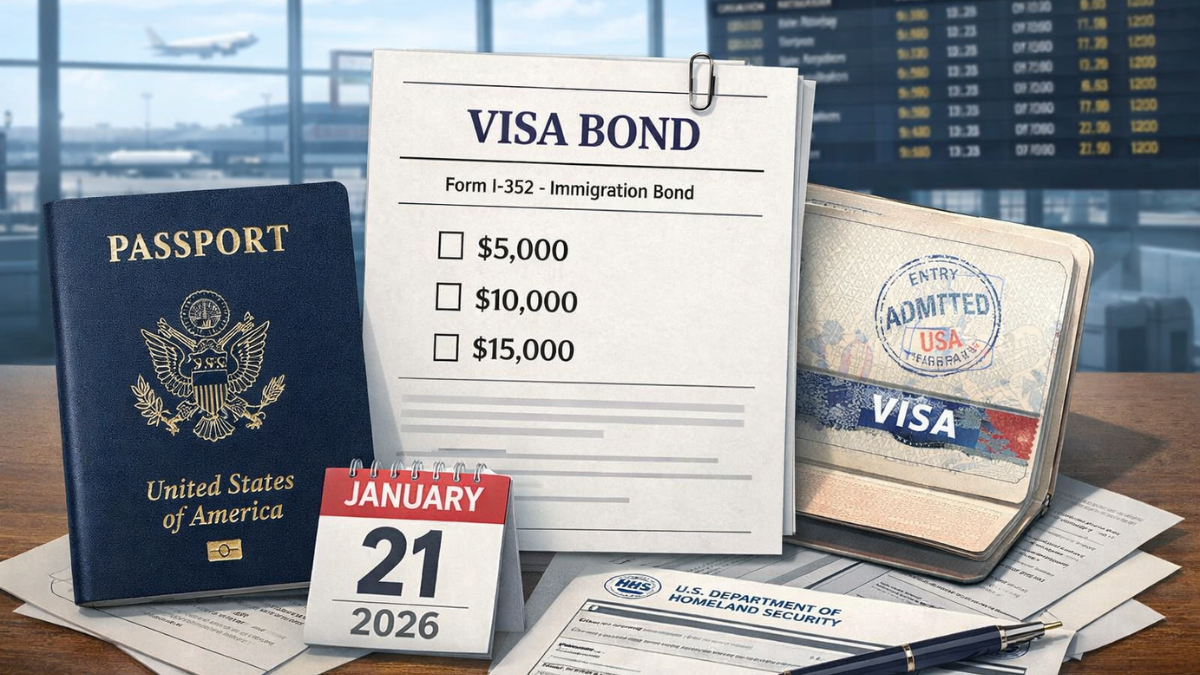


The United States has expanded a strict visa control measure that directly affects short-term visitors applying for B1/B2 business and tourist visas. Under this rule, eligible visitors from 38 selected countries may be required to deposit a refundable cash bond ranging from $5,000 to $15,000 before being allowed to enter the country.
This requirement is part of the Visa Bond Pilot Program, which is aimed at reducing visa overstays. The programme uses financial accountability as a tool to ensure that visitors follow the conditions of their stay and leave the US on time. The expanded list of countries and new entry rules significantly increase the reach of this pilot programme.
What Is the US Visa Bond Pilot Program
The Visa Bond Pilot Program was introduced as a compliance measure for B1/B2 visitor visas. Its main goal is to discourage visa overstays by placing a financial obligation on travellers considered to be at higher risk of overstaying their authorised period of stay.
The programme first came into effect on August 20, 2025, covering citizens of 13 countries. On January 8, 2026, the US State Department issued an updated list expanding the programme to 38 countries. From January 21, 2026, citizens of 25 additional countries will fall under this rule.
Countries are included based on data from the Department of Homeland Security’s Entry/Exit Overstay Report, which tracks B1/B2 visa overstay rates. Some countries were also included because they offer citizenship-by-investment programmes.
Visa pressure works: UK strikes deportation agreements with Angola, Namibia, and DRC
The programme operates under INA Section 221(g)(3) and a Temporary Final Rule that governs its implementation. It is scheduled to remain active until August 5, 2026.
Who Must Pay the Bond and How It Works
The bond requirement applies to citizens or nationals travelling on passports issued by countries listed under the programme. It applies only to B1/B2 business and tourist visa applicants who are otherwise found eligible for a visa.
Being eligible for a visa does not mean the bond will be waived. The decision is made only at the visa interview, based on a risk assessment conducted by a consular officer. The required amount may be set at $5,000, $10,000, or $15,000.
Applicants must not pay any bond unless they are clearly instructed to do so by a consular officer. Authorities have warned that paying money without official direction may result in loss of funds. Paying the bond does not guarantee visa approval.
If directed, applicants must complete Department of Homeland Security Form I-352 (Immigration Bond). Payment must be made only through Pay.gov, the official US government payment platform. Payments made through agents, third-party websites, or unofficial services are not accepted and are not protected by the US government.
U.S. visa crackdown ignites diplomatic retaliation as nations move to ban American travelers
Entry, Exit Rules, and Bond Refund Conditions
Travellers who post a visa bond must enter and exit the United States through designated ports of entry. Failure to do so may result in denied entry or an exit that is not properly recorded, which could lead to a bond breach.
Approved ports include major airports such as Boston Logan, John F. Kennedy International Airport, Washington Dulles, Newark Liberty, Atlanta, Chicago O’Hare, Los Angeles International Airport, Toronto Pearson, and Montréal-Trudeau. Some airports were added in August 2025, while others became valid from January 1, 2026. Additional ports will be added gradually.
The bond is automatically cancelled and refunded if the traveller leaves the US on or before the authorised stay period. It is also refunded if the traveller does not enter the US before the visa expires or is denied admission at a US port of entry.
If a traveller overstays, fails to depart, or violates visa conditions, the case is referred by the Department of Homeland Security to US Citizenship and Immigration Services for review. Actions such as applying to adjust status or claiming asylum may also trigger a bond determination.
The expanded visa bond programme places strict financial and travel conditions on selected visitors while keeping the core visa rules unchanged.