

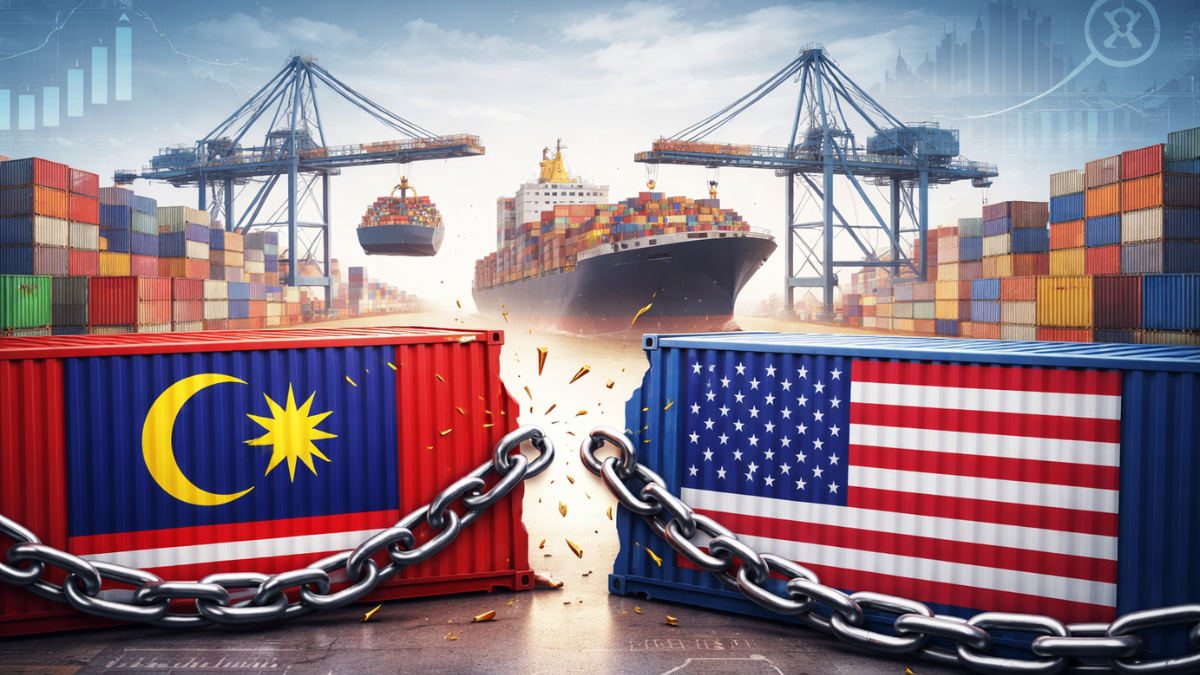


Malaysia has officially withdrawn from its trade agreement with the United States, becoming the first country to step away from Washington’s reciprocal tariff strategy. This move has drawn global attention, as it may influence how other countries respond to similar agreements.
The agreement, known as the Agreement on Reciprocal Trade (ART), is no longer valid. Malaysia’s trade ministry, led by Johari Abdul Ghani, confirmed that the deal is not suspended but completely void and no longer in effect. This means that all terms, benefits, and commitments under the agreement have ended.
The ART was originally signed on 26 October 2025 in Kuala Lumpur. It was formalised between Anwar Ibrahim and Donald Trump as part of efforts to strengthen trade ties. The agreement was designed to reduce trade barriers between the two countries.
Under the deal, Malaysia successfully reduced tariffs on its exports to the United States from a high level of 47 percent to 24 percent, and later to around 19 percent. In exchange, Malaysia provided wider market access and agreed to several policy changes that benefited the United States.
At the time, the agreement was seen as a strategic move to strengthen trade ties. It offered Malaysia better access to the US market while giving the United States more opportunities in Malaysia’s economy.
China expresses concern over US tariff plans after high-level Paris meeting
US Court Ruling Removes Legal Basis of Tariffs
The situation changed after a major legal decision in the United States on 20 February 2026. The US Supreme Court ruled that the president does not have the authority to impose broad tariffs under the International Emergency Economic Powers Act (IEEPA).
This ruling had a direct impact on the tariff system that supported the ART agreement. Since the tariffs were a key part of the deal, removing their legal basis made the agreement ineffective.
Following the court’s decision, the United States government introduced a new tariff policy. Instead of country-specific tariffs, a uniform tariff rate of 10 percent was applied to all trading partners under Section 122. This meant that all countries, whether they had agreements or not, were treated the same.
As a result, the special tariff reductions that Malaysia had secured under the ART agreement were no longer meaningful. Countries that had negotiated similar deals and made concessions were now facing the same tariff rate as those without any agreements.
This change removed the economic value of the agreement for Malaysia. The benefits it once provided were no longer available under the new system.
UK to raise steel import tariffs and reduce quotas under new strategy
Global Trade Impact and Ongoing US Trade Actions
Malaysia’s decision to cancel the agreement highlights a wider issue in global trade. Several countries, including major economies and developing nations, had previously faced tariffs ranging between 15 percent and 20 percent. Many of them had agreed to certain conditions in exchange for reduced tariffs.
With the introduction of a flat 10 percent tariff, these negotiated advantages have disappeared. This has created a situation where countries that made concessions are no longer receiving any special treatment.
In addition to these changes, trade pressure from the United States has continued. On 11 and 12 March 2026, the Office of the United States Trade Representative launched a new investigation under Section 301. This investigation targets several countries, including those that had earlier signed trade agreements.
These actions indicate that trade tensions remain active despite the shift in tariff policy. Countries are now facing a different type of challenge, where earlier agreements no longer provide the expected benefits.
Malaysia’s withdrawal marks the first formal exit from this tariff strategy. It reflects how sudden legal and policy changes can directly affect international trade agreements and their value.