

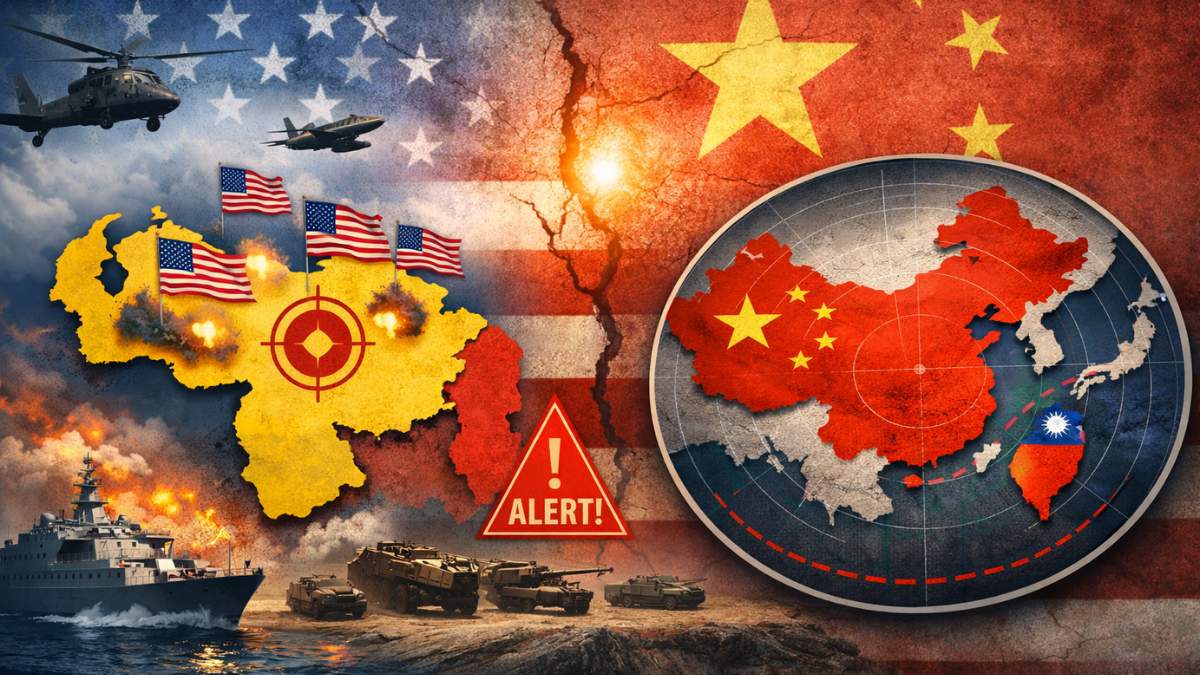


The world reacted strongly after the United States, carried out a bold operation to capture Venezuelan President Nicolás Maduro and his wife. The event quickly became a major topic on social media, including in China, where many users compared it to how tensions with Taiwan might be handled.
The US strike reportedly involved more than 150 aircraft and months of intelligence preparation. Helicopters approached Maduro’s compound shortly after 2 a.m., taking fire, before Maduro and his wife surrendered. The operation followed months of US efforts, including airstrikes on boats reportedly carrying illegal drugs.
News of the operation quickly spread to China, where social media platforms saw massive discussion. Some users suggested that the US action provided a “blueprint” for China to handle Taiwan. Others openly questioned international law, saying that if the US ignores international rules, China might also disregard them. These reactions highlight how dramatic events in one country can influence debates and speculation far across the globe.
Chinese Social Media Buzz and Official Response
The story quickly became a trending topic on Chinese platforms, with discussions gaining hundreds of millions of views. Many posts directly compared Venezuela’s situation to Taiwan. Some users suggested that China could use a similar surprise attack to seize Taiwan. Others mentioned Taiwan’s current leader, President Lai Ching-te, in their comments, often using derogatory terms.
BREAKING: Crypto markets rocked by claims Venezuela secretly holds over 600,000 Bitcoin
Despite the online enthusiasm, China’s official response was critical of the US strike. The Chinese Foreign Ministry demanded that Maduro and his wife be released and condemned the operation as a violation of international law. The ministry said the strike ignored the basic rules of international relations and violated the principles of the United Nations Charter. Earlier, China expressed shock at what it called the “blatant use of force against a sovereign nation.”
Taiwan’s government said it was closely monitoring the situation and emphasized cooperation with the US and other democratic countries to maintain regional security, stability, and prosperity.
Geopolitical Implications and Venezuela Ties
The US strike also highlighted broader geopolitical concerns. China has maintained strong ties with Venezuela in recent years, investing heavily and relying on it for oil. Venezuela has the world’s largest known oil reserves, and China is its largest customer. In recent days, the Trump administration increased pressure on this trade, sanctioning companies and oil tankers linked to China.
Experts say the operation could be seen by China as an example of how a powerful country intervenes in another’s affairs in the name of national security. Social media speculation suggested the US strike might influence China’s approach to Taiwan.
Military experts note that the US operation required months of intelligence, planning, and experience operating in hostile environments. Joint Chiefs Chairman Dan Caine described the complexity and risks involved in executing the strike. Chinese forces are considered less experienced for such operations, so analysts believe China might explore other options, such as targeted political pressure or neutralizing Taiwan’s leadership, rather than a full-scale raid.
The US action also drew criticism from state-run Chinese media, accusing the US of returning to colonial-era practices and exposing what it called resource imperialism. Chinese diplomats, including Special Representative Qiu Xiaoqi, were reportedly in Venezuela shortly before the strike, meeting with Maduro. It remains unclear if they were still in the country during the operation.
The strike has drawn global attention, showing how a single dramatic event in one country can influence discussions and fears worldwide. The operation highlights the complex balance of power, international law, and security in today’s interconnected world.