



Summary
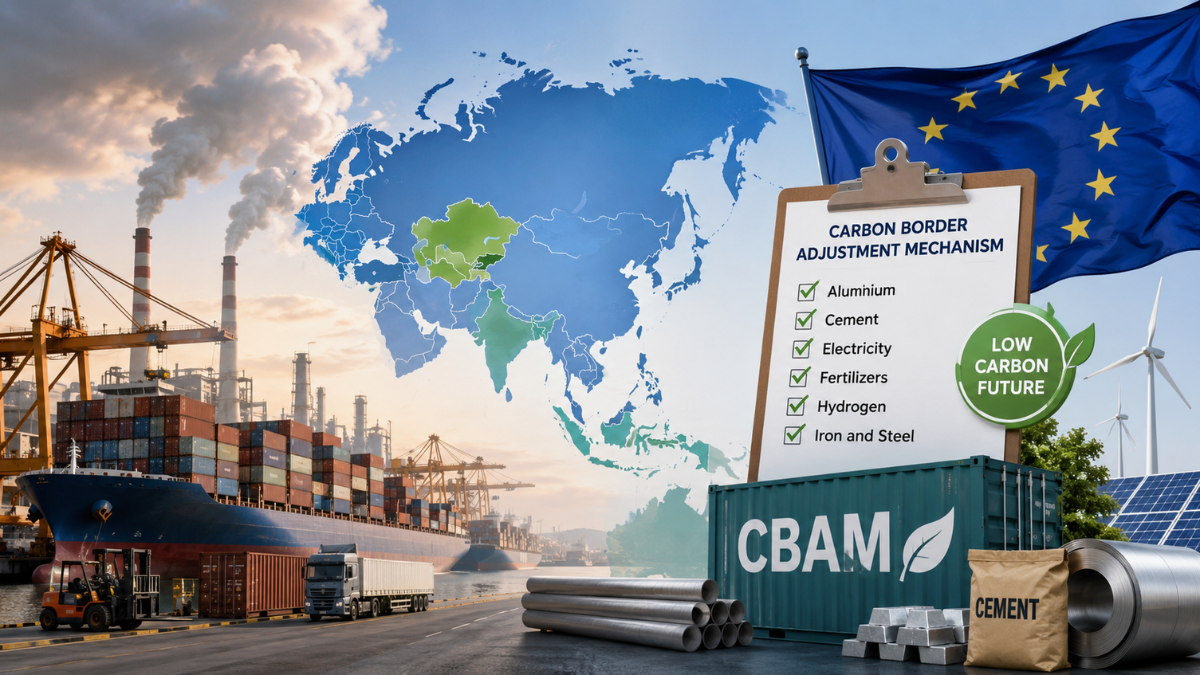
The European Union’s Carbon Border Adjustment Mechanism (CBAM) is changing the way many countries trade with Europe. It is designed to reduce carbon emissions by making sure imported products face a carbon cost similar to goods produced within the EU. CBAM applies to six sectors: aluminium, cement, electricity, fertilisers, hydrogen, and iron and steel. The system will be introduced gradually between 2026 and 2034.
A recent report by the United Nations Economic Commission for Europe (UNECE) explains how CBAM could affect Central Asian countries that export these products to the European Union. Instead of viewing CBAM only as a new trade rule, the report shows that reducing emissions across industries could lower carbon costs, improve competitiveness, and support cleaner energy systems.
What is CBAM and why does it matter for Asian exports?
CBAM is a European Union policy created to prevent “carbon leakage”. Carbon leakage happens when companies move production to countries with weaker climate rules while continuing to sell products in Europe. This can increase global emissions instead of reducing them.
Under CBAM, companies importing certain products into the EU must buy CBAM certificates. The price of these certificates is linked to the EU Emissions Trading System (EU ETS). This means imported goods with higher emissions could become more expensive in the European market.
The policy currently covers six major industries
Sector covered by CBAM Why it matters: Aluminium energy-intensive manufacturing: Cement: high carbon emissions during electricity production Power generation emissions Fertilisers Industrial emissions, hydrogen, future clean energy market Iron and steel One of the largest industrial emitters
The report explains that exporters may respond in different ways. Some may pay the additional carbon costs. Others may reduce emissions or introduce domestic carbon pricing systems that could reduce their CBAM payments. If businesses cannot remain competitive, exports to Europe could decline.
Several studies highlighted in the report show that the impact may differ from country to country. Some research suggests that exports of CBAM-covered products could decrease, while other sectors may partly offset those losses. Other studies estimate that countries with high carbon-intensive exports could face greater financial pressure under the new system.
How industries could adapt to CBAM compliance
The UNECE report studied another possible response to CBAM. Instead of focusing only on paying carbon costs, it examined what would happen if industries reduced emissions enough to match the carbon pricing levels expected under the EU ETS. This approach was described as CBAM compliance through decarbonisation.
The modelling focused on the same six CBAM sectors. It compared a baseline scenario with another scenario that included stronger climate measures, higher carbon prices and compliance with CBAM requirements.
According to the report, several important changes appeared across industries.
Key changes identified in the modelling include:
-
Less dependence on coal for electricity generation.
-
Greater use of wind and solar energy.
-
Increased use of nuclear power where applicable.
-
Higher use of hydrogen technologies.
-
More efficient industrial production methods.
-
Greater electrification of manufacturing processes.
-
Cleaner fuels replacing higher-carbon fuels.
For electricity production, the study found that Kazakhstan and Uzbekistan could significantly reduce coal use. Wind, solar power, natural gas, nuclear energy and hydrogen would replace a large share of coal-based electricity by 2050 in the modelled scenario.
Hydrogen production also changes under the model. Production increases because hydrogen is used more widely in power generation and industry. At the same time, cleaner production methods become more common than traditional technologies.
Manufacturing industries also become more energy efficient. In iron and steel production, newer technologies reduce energy use while replacing coal with electricity or lower-carbon fuels. Aluminium production becomes more efficient through upgraded combined heat and power systems, while cement production increasingly shifts toward electric heating instead of coal.
The report notes that these changes would require additional investments, especially in electricity generation, because cleaner industries would need more power. Electricity demand in the climate-focused scenario rises above the baseline as more industrial processes become electrified.
Carbon pricing and emissions monitoring become part of the picture.
The report explains that many economies around the world are already using carbon pricing systems or are developing them. It suggests that domestic carbon pricing could help countries reduce their exposure to CBAM because the EU allows importers to deduct carbon prices already paid in the exporting country.
The document also highlights that carbon pricing can generate government revenue, which could support industrial decarbonisation, green infrastructure and energy transition projects. It notes that Kazakhstan already operates an emissions trading system covering a large share of its greenhouse gas emissions, although further development would be needed for stronger revenue generation.
The report also places strong importance on monitoring, reporting and verification systems, commonly known as MRV. These systems help measure emissions accurately and improve data quality. Strong governance and transparent reporting are presented as important parts of managing carbon pricing systems.
Italy becomes first nation to ban lab-grown meat in defense of food tradition
Another area highlighted is methane emissions. While CBAM currently focuses on carbon dioxide, the report notes that methane is becoming an important part of climate action. Building the systems needed for CBAM compliance, such as emissions monitoring and reporting, could also support methane measurement and reduction programmes across the region.
The UNECE report states that, based on its modelling, comprehensive decarbonisation of CBAM-covered industries represents the most cost-effective way to reduce exposure to the EU’s carbon border rules while supporting cleaner industrial production across Central Asia.