

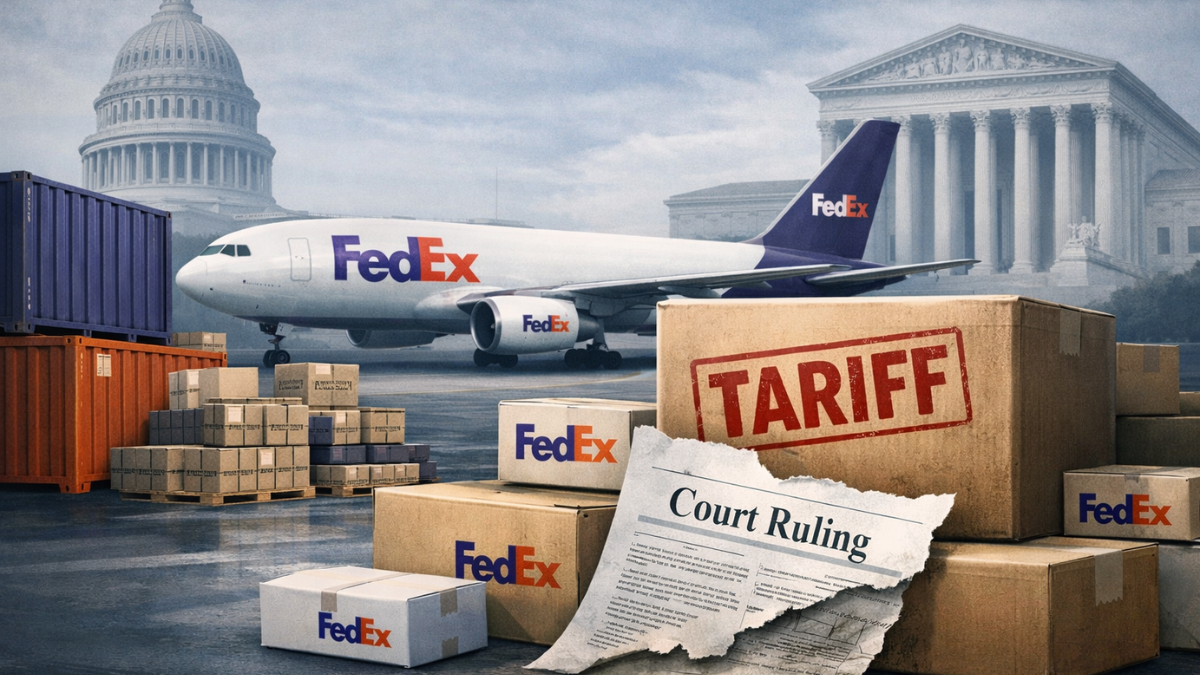


FedEx has sued the United States government after a major ruling by the Supreme Court of the United States struck down tariffs imposed under emergency powers.
The tariffs were introduced by Donald Trump using the International Emergency Economic Powers Act (IEEPA), a 1977 law that allows special economic actions during national emergencies. The administration used this law to impose broad tariffs during a period that was not officially a time of war.
On Friday, the Supreme Court ruled that the president had overstepped his authority. The justices said that only Congress has the power to impose tariffs during peacetime. As a result, the legal basis for the IEEPA tariffs was invalidated.
However, the court did not provide instructions on what should happen to the billions of dollars already collected under those tariffs. This has created uncertainty for companies that paid the duties and now want their money returned.
FedEx Seeks Full Refund Through Court Action
Just days after the ruling, FedEx filed a lawsuit in the US Court of International Trade. The company named U.S. Customs and Border Protection and its commissioner, Rodney Scott, as defendants. The agency was responsible for collecting the tariffs imposed under IEEPA.
Supreme Court setback pushes Trump to activate 1974 trade law for new global tariffs
In its legal complaint, FedEx said it had “suffered injury” from the tariffs and is seeking a full refund. As an importer of record, the company paid duties on goods entering the United States.
In September, FedEx stated that it expected a $1 billion financial hit in 2026 due to the tariffs and a related decision to end tariff exemptions on small packages valued under $800. That estimate was reported by Reuters.
Despite the Supreme Court’s landmark ruling, no official refund process has been established by regulators or the courts. FedEx said it has taken necessary action to protect its rights but acknowledged that the mechanism for refunds remains unclear.
Other companies are also seeking tariff refunds. These include Costco, Revlon, and EssilorLuxottica. Industry groups such as the United States Chamber of Commerce and the National Retail Federation are calling for a swift and clear refund system.
Billions Collected and Tariffs Still in Place
The tariffs were part of a wider trade policy shift that disrupted global trade. The policy began with disputes involving Canada, Mexico, and China before expanding to include most US trade partners, even those with existing free trade agreements.
Supreme Court ruling leads Trump administration to raise import tariffs amid refund claims
According to the Yale Budget Lab, the United States collected about $142 billion in tariffs under IEEPA as of mid-December 2025. Other estimates have placed the total closer to $175 billion.
Although the IEEPA tariffs have been struck down, other tariffs remain active. These include sector-specific measures under Section 232 of the Trade Expansion Act of 1962 and tariffs under Section 301 of the Trade Act of 1974.
The Yale Budget Lab reported that the average tariff rate facing US consumers is now 9.1 percent. While this is lower than the 16.9 percent average rate under the IEEPA tariffs, it remains the highest average tariff level since the end of World War II.
Experts have said it could take months or even years to untangle the complex web of tariffs and determine how refunds should be handled. The Supreme Court ruling did not outline a refund process, and the federal government has not yet announced a formal system for returning the collected funds.
FedEx’s case now moves forward in the Court of International Trade as companies seek repayment of tariffs collected under the invalidated emergency powers policy.