

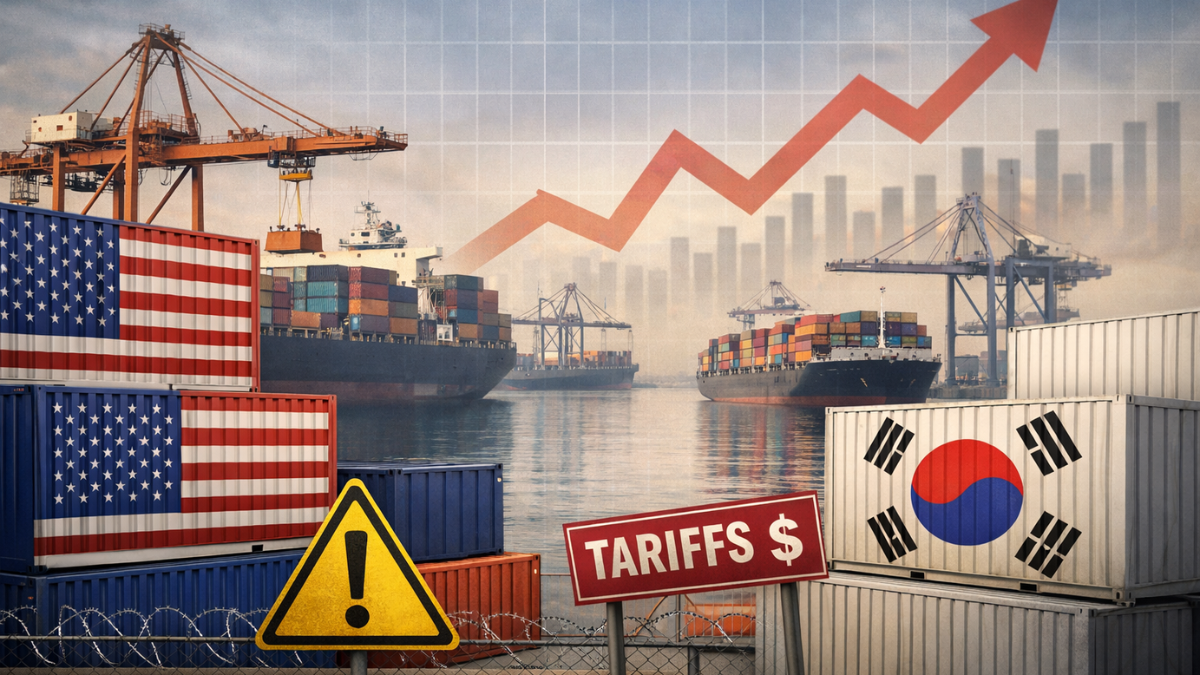


The United States has once again warned it may increase tariffs on goods imported from South Korea, including vehicles and other key products. President Donald Trump said the tariffs could be lifted to 25%, stating that South Korea has not yet carried out a trade agreement reached last year. That agreement was intended to limit U.S. tariffs on these products to 15%.
The agreement was reached in October 2025 during a visit to South Korea by President Trump, alongside South Korean President Lee Jae Myung. South Korea agreed to invest $350 billion into strategic U.S. industries in return for lower tariffs. However, the deal has yet to be written into South Korean law, which has become a major point of frustration for Washington.
The warning was issued publicly and has raised concerns among businesses and investors. While it remains unclear what specifically triggered the latest statement, ongoing delays and additional trade frictions appear to be key factors.
Why the Trade Deal Has Not Been Implemented Yet
South Korea’s delay in carrying out the trade deal is largely tied to economic and administrative challenges. One major concern is the country’s currency. Over the past six months, the South Korean won has weakened by nearly 7% against the U.S. dollar. Financial authorities worry that sending large amounts of money overseas could further weaken the currency.
Trump tariffs put Audi’s US factory at risk as Volkswagen counts $2.5bn hit
Finance Minister Koo Yun-cheol has said that it is unlikely the investment can begin in the first half of this year due to foreign exchange instability and administrative issues. He noted that under current conditions, large investments abroad are difficult to manage safely.
Bank of Korea Governor Rhee Chang-yong has also expressed concern, stating that he would not support overseas investment outflows if currency markets became unstable. Authorities fear that a rapid outflow of $350 billion could push the won to levels not seen since the global financial crisis.
Beyond currency issues, the investment plan must go through a detailed approval process. Projects must be reviewed by a management committee overseen by trade and finance officials, who assess commercial viability and legal compliance. This has slowed progress further.
Another major hurdle is legislation. To avoid disrupting the domestic currency market, the government plans to create a special fund to raise foreign currency. This requires a new law to be passed by the National Assembly. Although the ruling Democratic Party holds a majority, the bill has been stalled in a parliamentary committee chaired by the opposition People’s Power Party, delaying implementation.
Additional Trade Frictions Adding Pressure
Other trade-related tensions have also added strain to U.S.–South Korea relations. One key issue involves U.S. technology companies operating in South Korea.
A major data breach last year at Coupang, a U.S.-listed e-commerce company and South Korea’s largest online retailer, escalated into a broader dispute. The company has alleged that South Korean regulators singled it out with public criticism and enforcement actions, causing a loss in market value and harming U.S. investors.
South Korean Prime Minister Kim Min-Seok addressed the issue during talks in Washington with U.S. Vice President JD Vance, denying claims of unfair treatment. He said regulators acted according to the law. U.S. officials have requested that the issue be handled carefully to avoid escalation.
Comparisons with Japan have also played a role. Japan reached a similar trade framework with the United States last July but moved faster to implement it. Its parliament approved the agreement in December and quickly began discussions on investment projects.
Together, delayed investment commitments, currency concerns, legislative gridlock, and disputes involving U.S. companies explain why President Trump has again threatened to raise tariffs on South Korea.