


An account based on ‘The Indian Media Barometer 2025- Healthscan of the Fourth Pillar of Democracy’
“No substantial famine has ever occurred in any independent and democratic country with a relatively free press.”
– Prof Amartya Sen, Nobel Laureate
At a time when the Indian news media is heavily polarised on political issues and undeniably under the heavy influence of a variety of forces including the government, corporate bodies and ideological groups, what is the state of the Indian News Media today as we approach the close of 2025?
What do senior journalists, serving editors, veteran journalists and informed members of the public feel about the state of the Indian media today?
Press Freedom is being tested in various ways in India and a variety of influential forces are trying to tame the Indian press. This author is of the view that this should be seen as a passing phase as the fundamentals of journalism are intact in India. Press freedom cannot be suspended permanently, given India’s post-Independence history and complexities. Journalists can and should assert themselves in various ways.
*
The Indian Media Barometer 2025- Healthscan of the Fourth Pillar of Democracy report is based on three days of focused deliberations held from 29th September – 1st October at Sri Balaji University, Pune with valuable support for this initiative provided by the university and Sri Balaji Society. The project was conceptualised by Anand Agashe, veteran journalist and conclave consultant, and organised by Vinita Deshmukh, Editor, Corporate Citizen and In-Charge, Balaji School of Media, Communication & Journalism.
A previous exercise of this nature was conducted by Agashe in 2012 and hosted by Friedrich Ebert Stiftung, an independent German organisation dedicated to promoting social democracy, freedom, justice, and solidarity.
Presenting his perspective on the state of the media, Agashe says in the report, while there is “a bombardment” of advertisements, advertorials and innovative forms of promotional packages, in addition to genuine journalistic content, the crisis in Indian journalism has assumed new dimensions in the last decade because of the increased government pressure and the concentration of ownership of media houses in a few hands. For such media owners their earnings primarily came from other businesses, and it is unrealistic to expect them to allow media content that would affect their ‘core’ business interests.
He attributes the viral spread of social media “whose main characteristics are unhindered inclusivity, interactivity, and instantaneity,” to the “shortcomings of the conventional media.” (This, one may argue, is partly true, as the viral spread of social media is largely due to the ease of technological access for the common man, and very few entry level barriers where anyone- from a college student to a millionaire– can set shop at virtually no cost and create content.)
Agashe correctly notes that this media (which can no longer be called ‘new’), cuts across identities and backgrounds of people; opens up avenues for their personal growth in areas of their domain knowledge and creates ‘common interest communities’, all leading to making social media a mass addiction in all parts of the world.
While the journalistic functions of informing, educating and entertaining people rides on this mass addiction, the absence of robust structures and time-tested systems for verification of content makes social media platforms vulnerable to the dissemination of misinformation, untruths, morphing, fake news, and unsubstantiated views, says Agashe.
While being helpful and informative when the information is credible, social media can also be put to effective use. It can also become destructive and anti-national as it can be misused easily due to the absence of editorial oversight, unclear structure of accountability, weak laws, and weaker enforcement, resulting in an unhealthy public discourse.
In the coming years, the media market in India is set to grow in conventional media and social media because of their strengths and weaknesses. This will be reflected in bigger circulation, more subscribers, wider reach, and additional advertising revenue. Amidst this business environment, the real challenge for journalism in India will lie in ensuring space for high quality, credible journalism in both streams.
The spread, depth and trustworthiness of journalistic content will not happen on its own and market forces will continue to pose hurdles, says Agashe.
While institutional media houses will make efforts to meet this challenge for their own survival, this won’t be enough. The onus will also lie on citizens “because journalism is too important to be left to professional journalists alone.” If the citizens/citizen journalists are serious about preserving the sanctity of the Fourth Pillar of Democracy in conventional and social media, they ought to be made aware of at least the basics of the discipline of journalism. Media houses, individual journalists, and members of civil society can play a crucial role in spreading this media literacy.
Therefore, a thorough ‘healthscan’ of the present-day media by its internal and external stakeholders is necessary to identify the strengths and weaknesses, and this is the purpose that is sought to be served by The Indian Media Barometer 2025.
Vinita Deshmukh pointed out that journalism, at its core, is about speaking truth to power. The media serves as the watchdog of democracy — a powerhouse entrusted with keeping those in authority accountable, ensuring that the custodians of public funds do not misuse them for personal or political gain.
This analytical report, she noted, is the outcome of collective introspection — “a diagnostic reflection on where Indian media stands today, as viewed by its internal and external stakeholders.” Vinita described the report as “both a mirror and a map: a mirror to assess how far the media has drifted from its core purpose, and a map to guide it back to its foundational ideals.”
Participants
Twenty two panellists comprising media experts, senior working journalists, media executives, educators, civil society activists and Public Relations professionals participated in the three-day closed-door discussions. Two days were devoted to conventional media (print, television and radio) while one day was reserved for social media. All the discussions were moderated by a senior journalist/researcher. The participants assessed Indian media’s performance on 57 parameters clubbed under six segments.
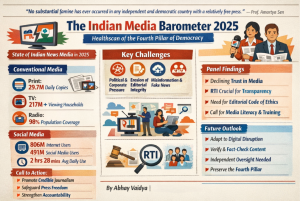
Indian News Media Stats:
Print Media
- Average daily newspaper sales: 29.7 million copies (Jan–Jun 2025), as per Audit Bureau of Circulations
(This marks a recovery after several flat years and shows that print remains a credible, high trust reach medium in many markets.) - Print continues to offer strong city-level and local penetration.
Television
- widest-reach medium in India
- Independent reports estimate 217–230 million TV-viewing households (FY2024–FY2025)
- TV ad market valued in tens of thousands of crores
- TV provides national mass reach and event-driven spikes in viewership
Radio
- All India Radio’s network covers 98% of the population, making radio near-universal in availability
- Commercial FM stations reach urban commuters and local clusters, offering consistent weekly reach
- Radio fills regional, hyperlocal, and drive-time reach gaps not covered as efficiently by other media
Overall Media Mix Insight
- Print- trusted, credible, strong local penetration
- TV- mass national reach plus major event peaks
- Radio- local, drive-time, and regional reinforcement
With the right planning, all three remain measurable and monetisable in a converging media ecosystem
Social Media:
- At the start of 2025, India had 806 million internet users
- There were 491 million social media user identities, giving social networks reach to about one third of the population and a majority of all online users
- Indians spend an average of 2 hours 28 minutes per day on social platforms, indicating deep habitual use and multiple daily brand touchpoints
Platform Mix
WhatsApp: Dominant messaging platform for distribution, community building, and direct engagement
YouTube + Facebook/Instagram: Major drivers of discovery, video reach, and influencer-led amplification
Engagement Patterns: Engagement varies by format and platform
- Industry trackers consistently show higher click-through and view rates for short-video formats and messaging-led campaigns than for static posts. This creates strong opportunities for video-first and conversational content strategies.
Implications for Newsrooms & Brands
- Social media can deliver mass amplification, rapid feedback loops, and real-time audience reactions. However, organic reach is inconsistent, and paid promotion is often required to achieve scale.
- Data-driven targeting and measurement are essential: platforms offer fine-grained segmentation, while independent analytics and third-party verification help prevent inflated reach claims.
Findings:
Conventional Media: While All India Radio retains a reputation for authenticity, it lacks editorial freedom and depth, often reflecting a pro-government stance. In contrast, print and television media, though diverse and far-reaching, struggle with declining public trust, commercial interference, and weak inclusivity.
English-language establishments were criticised for Delhi-centric and Western-biased coverage, whereas regional media showed stronger local engagement but limited global perspective.
Panellists expressed concern over shrinking newsroom diversity—especially across caste lines. Concern was also expressed over the erosion of cross-verification practices, linking these to the political and ideological polarisation of journalists and the ‘breaking news’ culture.
In the educational role, the media’s coverage of science, agriculture, health, and climate change was seen as episodic and shallow, driven more by ownership and advertiser priorities than by public interest. The neglect of rural, social, and environmental issues was seen as a serious shortcoming.
There was unanimity that the Right to Information Act, 2005 (RTI) remains an indispensable investigative tool for Indian journalists. It has transformed reporting from hearsay-based to document-based journalism and empowered reporters across states to expose corruption, verify official claims, and bring transparency to public life.
Though its effectiveness has suffered in recent years due to bureaucratic delays, political opacity, and procedural dilution, RTI continues to be one of the most democratic tools available to journalists—and a key pillar of accountability in India.
Media establishments must encourage publishing of news reports based on certified documents obtained through RTI.
Editorial Integrity, External Pressures & Human Resources
- Deep concern was expressed over the absence of an Editorial Policy document in Indian news media establishments, by and large. The absence of such written editorial policies resulted in newsrooms being exposed to managerial fiat, economic coercion and selective bias.
The panellists stressed on the need for codified editorial charters—open to public scrutiny– to strengthen transparency and accountability.
- The ‘performative debates’ on Television came under criticism. Print publications had the advantage of time, but this was not utilised well for verification.
- Shrinking commitment to secular values and an excessive focus on Hindu–Muslim narratives had become conspicuous.
- The conference mapped systemic pressures: political coercion, advertiser influence, PR gatekeeping, social-group intimidation, and financial levers that shape agenda-setting, producing subtle self-censorship, job insecurity and a growing psychological toll from trolling and online abuse.
- The quality of news reporting depends on recruitment, training, mentorship, and fair remuneration. Short courses, inadequate field exposure, and low salaries were blamed for diverting talent to PR and digital marketing, eroding the depth of journalism.
- Participants called for ethical business practices, institutional safeguards, stronger newsroom autonomy, and an independent ombudsman in media establishments.
- With regards to journalism training, panellists called for diversification of curricula and career paths—digital fluency, specialised beats and roles such as digital-literacy trainers and wellbeing coaches—to sustain journalism’s public-service function amid disruptive change.
Digital Media
- Digital media’s disruption of traditional journalism, weighing democratising gains against ethical and institutional costs came under scrutiny.
- Instantaneity, interactivity and expanded access were identified as strengths even as speed, algorithmic incentives, and click-driven economics undermined verification, depth and authenticity.
- Weak sourcing of information, blurred lines between paid and editorial content, AI-generated material, and the mutable permanence of online records were identified as threats to accountability.
- Trolling coordinated disinformation and PR gatekeeping were identified as novel pressures that distorted the news agenda and inflicted psychological harm on journalists and audiences.
- Need was felt for adaptive regulation, transparent disclosures, robust verification protocols and widespread digital-media literacy for producers and consumers.
- Digital Media platforms need to demonstrate professional standards. Legal ambiguity over platform responsibility needs to be addressed.
The author, Abhay Vaidya, is a senior journalist and former Director, Pune International Centre public policy research think tank. He was one of the participants in this conclave.