

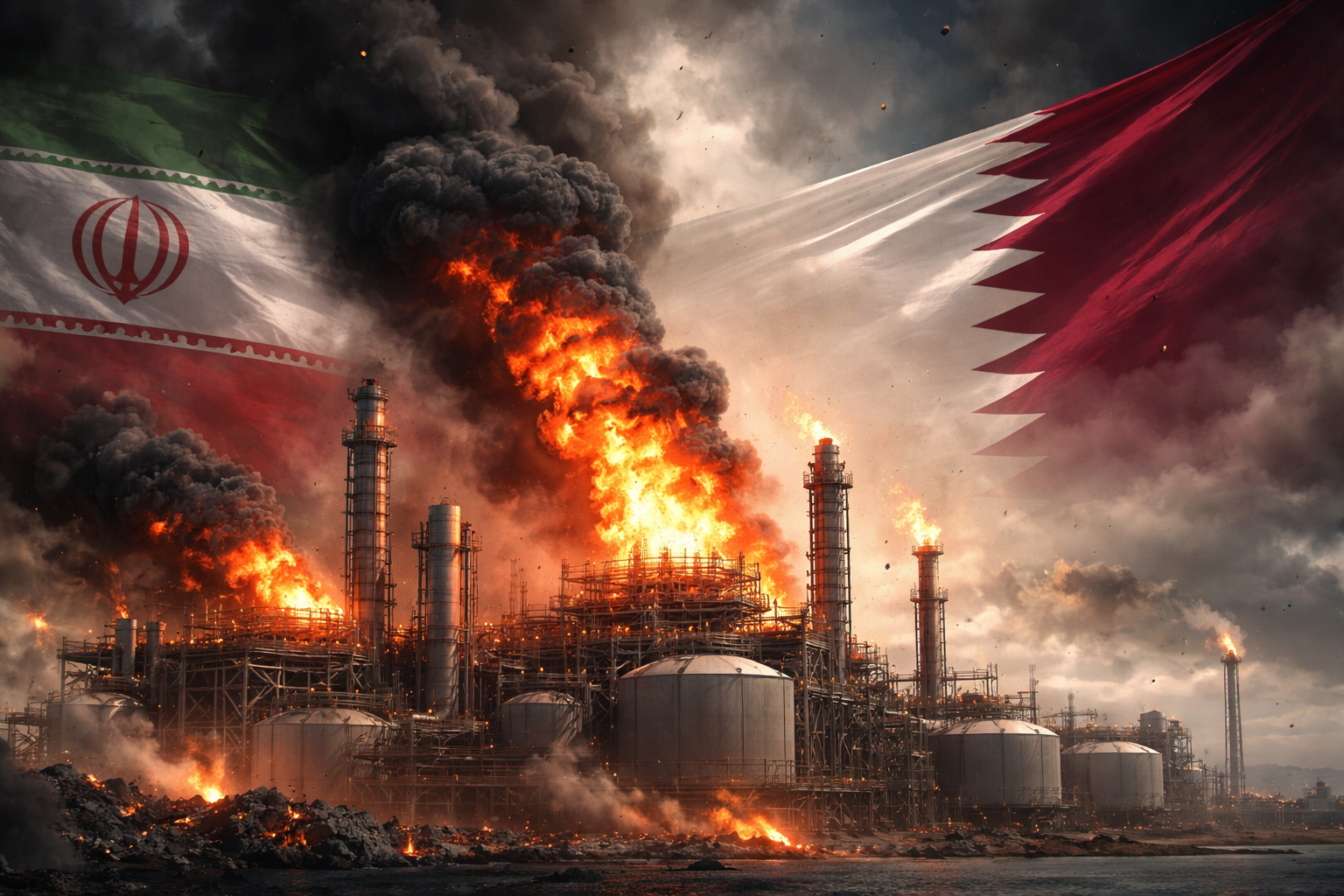


The intensifying conflict between Israel and Iran has drawn global attention to two of the world’s most critical energy hubs — South Pars Gas Field and Ras Laffan Industrial City — both of which sit at the heart of the shared North Field–South Pars gas reserve. As tensions escalate following military actions involving the United States and Gulf nations including Qatar, Saudi Arabia and the United Arab Emirates, energy markets and geopolitical stability face renewed uncertainty. The strategic importance of these sites—combined with their proximity to the vital Strait of Hormuz—means any disruption risks rippling across global oil and gas supply chains.
In a dramatic escalation, Israel launched a strike on Iran’s South Pars gas infrastructure on Wednesday, targeting facilities tied to the country’s most critical energy source. Within hours, Iran retaliated by launching missile strikes across the Gulf, including a direct hit on liquefied natural gas (LNG) infrastructure at Ras Laffan in Qatar early Thursday. The exchange marks a dangerous widening of a conflict that has already extended beyond direct Israel-Iran hostilities into a broader regional confrontation.
According to Iranian state media, the South Pars strike affected natural gas processing units linked to the massive offshore field. The field, located near Iran’s southern coast, is responsible for roughly 80 percent of the country’s domestic gas supply. Any disruption here threatens not only Iran’s internal energy stability but also its limited exports to neighboring countries such as Iraq, which relies heavily on Iranian gas for electricity generation.
Gulf countries face economic strain as Iran war disrupts energy and travel
Iran’s response was swift and strategically calculated. Missiles targeted Ras Laffan Industrial City, the backbone of Qatar’s LNG export economy. Fires were reported at multiple facilities, though Qatari authorities confirmed that the situation was brought under control without casualties. Still, the symbolic and economic implications of the strike are significant.
Qatar strongly condemned the attack, calling it a “blatant violation” of sovereignty. State-owned energy giant QatarEnergy confirmed damage across multiple LNG facilities and warned of operational disruptions. In a sharp diplomatic response, Doha expelled several Iranian officials, signaling a potential breakdown in already fragile regional relations.
The United States, meanwhile, distanced itself from Israel’s initial strike. President Donald Trump stated that Washington had no prior knowledge of the attack on South Pars and criticized Iran’s retaliation against Qatar. He also issued a stark warning, suggesting that further escalation could trigger overwhelming military action against Iran’s energy infrastructure.
Beyond the immediate military exchanges, the real significance of these attacks lies in the strategic value of the targeted sites. South Pars, forming one half of the world’s largest natural gas reserve, is essential to Iran’s domestic economy. While it contributes little to global exports, any sustained disruption could destabilize Iran internally and strain energy supplies in countries dependent on its gas.
Satellite internet crackdown grows in Iran as black-market Starlink sales rise
Ras Laffan, however, carries far greater global consequences. As the world’s largest LNG production and export hub, it accounts for roughly 20 percent of global LNG supply. It plays a crucial role in balancing energy demand across Europe and Asia, especially in the aftermath of the Russia-Ukraine War, which forced many European nations to shift away from Russian pipeline gas toward LNG imports.
Although analysts suggest that the immediate supply shock may be limited—due in part to prior production suspensions at Ras Laffan—the longer-term outlook is far more concerning. Extensive damage to infrastructure could delay the resumption of full production capacity by months, tightening global supply and keeping prices elevated.
Indeed, markets have already reacted sharply. European gas prices surged to their highest levels in over three years, while Brent crude climbed to $115 per barrel, nearly doubling from pre-war levels. The volatility underscores how sensitive global energy markets are to disruptions in the Gulf.
The broader regional response also signals rising risks. Saudi Arabia has intercepted incoming missiles and warned that its restraint has limits. The UAE has reported disruptions at key energy facilities following intercepted attacks. These developments suggest that the conflict is no longer confined to bilateral strikes but is evolving into a wider regional crisis involving multiple energy-producing nations.
Perhaps most concerning is the continued threat to the Strait of Hormuz. Roughly 20 percent of the world’s oil and gas passes through this narrow waterway. Any sustained closure or disruption would trigger a severe global energy shock, affecting everything from fuel prices to electricity generation worldwide.
For major LNG importers such as Japan, India, and European economies, prolonged instability could translate into higher energy costs and economic strain. Emerging economies, particularly in the Global South, may face even harsher consequences as rising prices lead to reduced access and demand destruction.
In essence, the strikes on South Pars and Ras Laffan are not isolated military actions—they are strategic blows aimed at the very foundation of the global energy system. As the conflict deepens, the world is watching not just a regional war unfold, but a potential energy crisis that could reshape markets, alliances, and economic stability for months—if not years—to come.