

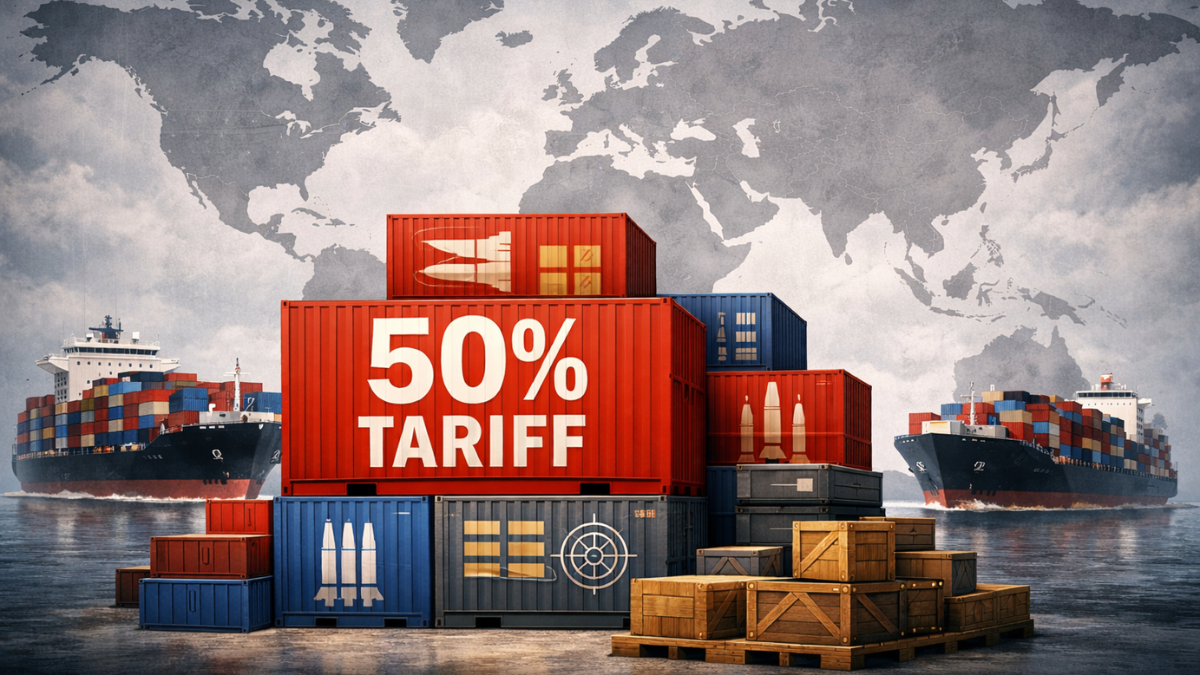


The United States has issued a strong warning that is drawing global attention. Donald Trump announced that any country supplying military weapons to Iran could face a major economic penalty. The proposed action includes a 50 percent tariff on all goods exported to the United States from those countries.
This message was shared publicly in a brief statement. It came just hours after a two-week ceasefire agreement with Iran. The timing has made the announcement more significant, as tensions in the region remain high.
The tariff threat means that if a country is found helping Iran with weapons, all its exports to the United States could become much more expensive. This includes everyday goods, industrial products, and key materials.
However, the announcement did not explain how such a decision would be enforced. No legal authority or specific law was mentioned that would allow immediate action.
Legal Questions and Policy Challenges
Experts quickly raised concerns about the practicality of this move. Rachel Ziemba noted that there is no immediate legal tool available to impose such tariffs quickly. In the past, the United States has used the International Emergency Economic Powers Act (IEEPA), a 1977 law, to impose sanctions on countries like Iran, Russia, and North Korea.
US government refuses aluminum tariff relief request linked to Novelis plant shutdown
However, this law has mainly been used for financial sanctions, not wide-ranging tariffs. Earlier this year, the Supreme Court ruled that IEEPA could not be used to impose broad global tariffs. Following this, a lower court ordered refunds of about $166 billion collected under similar policies.
This decision has created a major obstacle. Without IEEPA, there is no quick way to enforce such tariffs. Experts say that any new tariffs of this scale would require approval from Congress or would need to follow other trade laws.
Alternative tools like Section 301 and Section 232 could be used. These allow tariffs in cases of unfair trade practices or national security concerns. But both require detailed investigations, public notices, and time for responses. This process can take months.
Because of these legal limits, the proposed tariffs cannot be implemented immediately. This has led analysts to view the announcement as more of a warning than a direct policy action.
Focus on Global Powers and Trade Impact
Although no countries were named, the warning is widely seen as targeting China and Russia. Both have been linked to supporting Iran’s military capabilities in the past through technology, missile systems, and defense equipment.
Reports have suggested that Iran has considered purchasing advanced weapons, including supersonic missiles, from China. There have also been claims that Chinese firms supplied equipment that could support Iran’s military production. At the same time, both China and Russia have denied recent involvement.
Josh Lipsky said the message is likely directed at China and would be understood that way globally. The economic impact of such tariffs could be serious. If applied, they would raise the cost of imported goods in the United States, affecting businesses and consumers.
Trade between the United States and Russia has already shifted. Imports dropped sharply after the 2022 Ukraine conflict and sanctions. However, in 2025, imports rose again to $3.8 billion. These included palladium, fertilizers, and nuclear-related materials.
At the same time, tariffs on Chinese goods had decreased after the court ruling. Imposing a new 50 percent tariff would reverse that trend and could increase trade tensions.
The timing is also important. A planned meeting between Donald Trump and Xi Jinping is expected in mid-May. Introducing strict tariffs before such talks could complicate discussions.
The situation highlights the connection between global politics, trade rules, and economic decisions, while the actual enforcement of the proposed tariffs remains uncertain due to legal and procedural limits.