

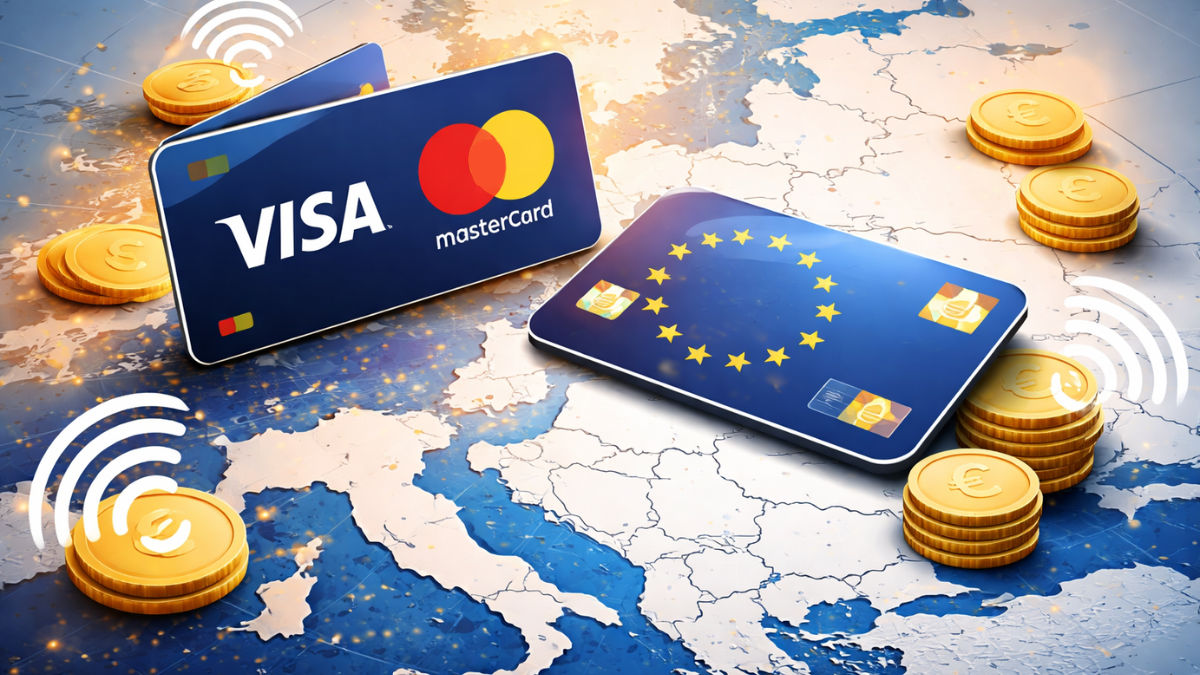


Europe is raising serious concerns about how everyday payments are handled across the eurozone. Most card payments depend on companies based outside Europe, and banking leaders say this dependence has become risky. As cash use continues to fall, card and digital payments have become essential for daily life, making the issue more urgent.
Payment systems are now viewed as critical infrastructure. People use them to buy food, travel, and shop online. European officials fear that relying heavily on foreign-controlled payment networks could expose the region to disruption if political relations were to worsen. What was once seen as simple financial technology is now considered a matter of economic security.
Visa and Mastercard Dominate Eurozone Payments
Visa Inc. (NYSE: V) and Mastercard Inc. (NYSE: MA) currently process nearly two-thirds of all card payments across the eurozone, raising concerns among European officials that the region has become overly dependent on U.S.-based payment networks for everyday transactions.
The dependence is especially strong because many countries lack domestic alternatives. Thirteen eurozone member states do not have a national card scheme at all. Even where domestic systems exist, their use is declining as international cards are more widely accepted for travel, online shopping, and cross-border payments.
Martina Weimert, chief executive of the European Payments Initiative, said Europe is “highly dependent on international payment solutions.” She explained that while some countries have strong national payment systems, there is no single solution that works across borders.
EU expands sanctions on Russian oil, banks, and trade under 20th package
Weimert warned that Europe lacks a shared payment network that can operate throughout the eurozone. She said that if independence is considered important, action is needed urgently. With digital payments replacing cash, any disruption to card systems could affect daily life quickly.
Concerns have also been raised by other officials. Belgium’s cyber security chief recently warned that Europe has “lost the internet” due to the dominance of foreign technology companies. Similar fears are now being applied to payments.
Former European Central Bank president Mario Draghi said that deep international integration has created dependencies that could be misused. He warned that systems once designed for cooperation can become tools of leverage when political relationships change.
Fragmented National Systems and the Digital Euro Debate
Payment systems across the eurozone remain fragmented. Some countries support domestic digital transfers, in-store payments, and e-commerce, while others support only one or none of these options. Several countries lack any domestic payment alternative.
Even strong national systems usually work only within their own borders. This forces consumers and businesses to rely on Visa and Mastercard for cross-border payments, reinforcing their dominance.
Past private-sector attempts to build a shared European payment system have struggled. The European Central Bank said earlier initiatives failed to scale because participating companies could not agree on common standards.
EU revives stalled U.S. trade deal after Trump backs down on Greenland threat
The European Payments Initiative, backed by banks including BNP Paribas and Deutsche Bank, launched a digital payment service called Wero in 2024. Designed as an alternative to Apple Pay, Wero claims 48.5 million users in Belgium, France, and Germany. The service plans to expand into online and in-store payments.
At the same time, the European Central Bank is promoting the digital euro, a public project aimed at enabling digital payments across the eurozone. Merchants would be required to accept digital euros both online and in stores by 2029.
Piero Cipollone, an ECB executive board member, said Europeans want to avoid becoming overly dependent on payment systems that are not under their control. The digital euro infrastructure would also be open to private companies.
The project has divided opinion. Some banks argue it could undermine private initiatives. A vote in the European parliament later this year is expected to be closely contested.
Aurore Lalucq, chair of the European parliament’s economic committee, said the digital euro could provide a foundation for building an alternative to Visa or Mastercard. However, Weimert warned that if geopolitical tensions increase, the digital euro may arrive too late to address immediate risks.