

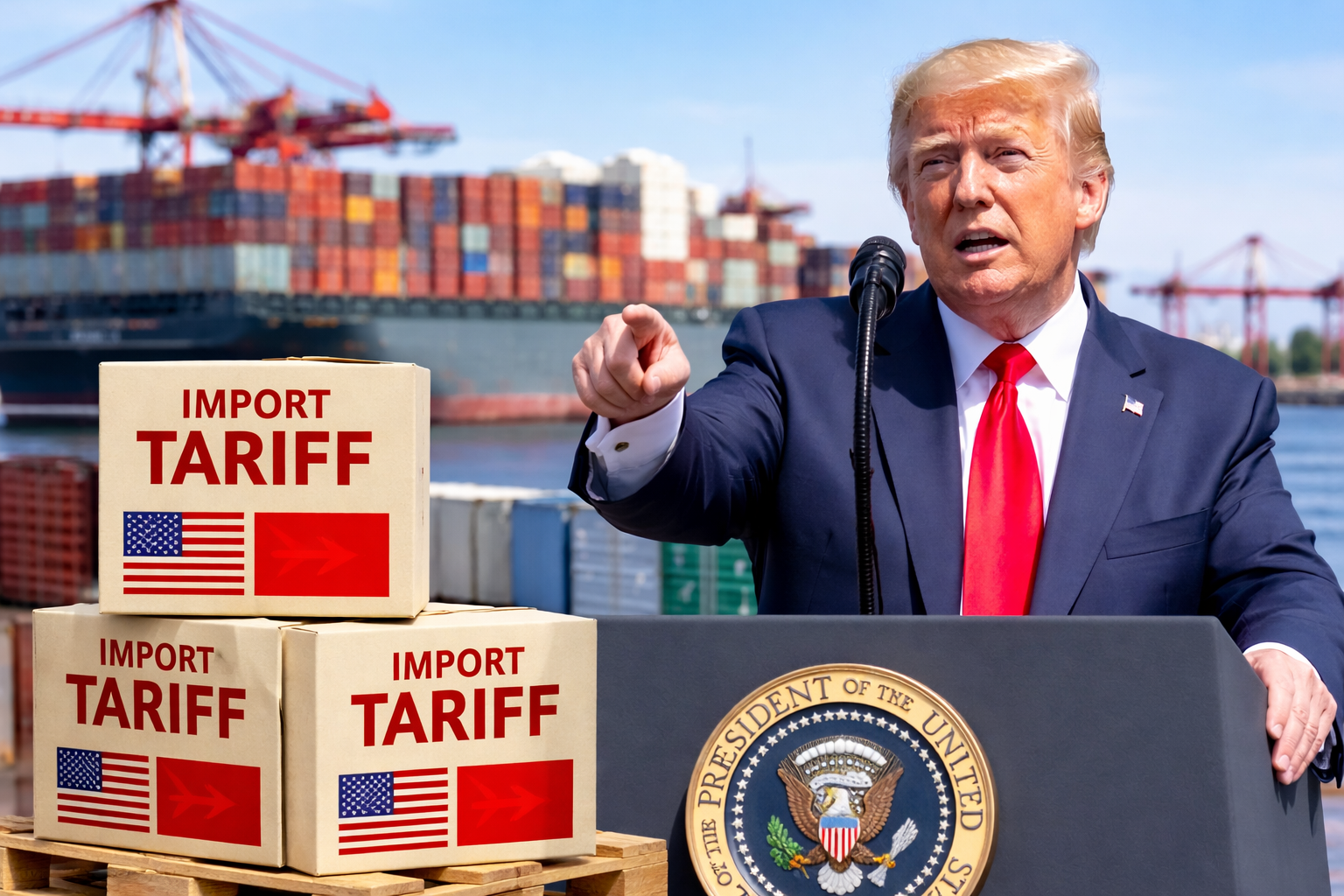


The debate over Greenland has taken a sharper turn after U.S. President Donald Trump suggested that countries could face tariffs if they do not support the United States taking control of the Arctic island. The comments immediately drew attention in Washington, Europe, and Greenland itself, as lawmakers from both parties were already in Denmark trying to calm the situation and reduce growing tension.
Greenland is a large island in the Arctic region. It is a self-governing territory that belongs to Denmark, which is a NATO ally of the United States. For months, President Trump has openly said that he believes the U.S. should control Greenland. He has argued that the island is critical for national security and global strategy. Earlier this week, he went further, saying that anything short of Greenland being under U.S. control would be “unacceptable.”
On Friday, Trump added a new and unexpected element to the dispute. He said he might use tariffs as a tool to pressure other countries into backing the U.S. position on Greenland. This was the first time he publicly linked trade penalties to the Greenland issue, making the situation more serious and more complicated.
Tariffs enter the Greenland dispute
President Trump made his comments during an event at the White House that was focused on rural health care. While speaking, he referred to past moments when he had threatened European allies with tariffs on pharmaceutical products during trade negotiations. He then said he might take a similar approach over Greenland.
Trump redraws trade lines: Iran ties now trigger automatic 25% U.S. tariffs worldwide
He explained that Greenland is needed for U.S. national security and suggested that countries refusing to support U.S. control could face economic consequences. By mentioning tariffs, Trump signaled that trade pressure could be used as leverage in a dispute that had already strained relations with European partners.
This statement immediately raised concern because tariffs affect everyday goods, industries, and jobs. When tariffs are imposed, companies often pass higher costs on to consumers. That means ordinary people can end up paying more for medicine, food, or other products. The idea that Greenland could now be tied to tariffs made the issue feel closer to home for many countries.
So far, Trump has not explained which countries could be targeted or what goods could be affected. Still, the message was clear: Greenland is not just a diplomatic issue anymore, but one that could spill into trade and economic relations.
Earlier in the week, officials from Denmark and Greenland had already traveled to Washington to meet with U.S. leaders. They spoke with the U.S. vice president and the secretary of state. Those talks did not resolve the disagreement, but they led to the creation of a working group. Even that move caused confusion, as Denmark and the White House described the purpose of the group in very different ways.
European leaders have been firm in their response. They have repeatedly said that only Denmark and Greenland have the right to decide the future of the territory. In response to the growing pressure, Denmark announced that it would increase its military presence in Greenland, working together with allies to strengthen security.
500% tariffs loom as U.S. targets countries still buying Russian oil and uranium
Congress tries to lower the temperature
While the White House tone has grown tougher, a group of U.S. senators and House members traveled to Copenhagen with a very different message. The bipartisan delegation met with Danish and Greenlandic lawmakers, as well as senior leaders including Denmark’s prime minister.
Members of the delegation spoke about the long history between the United States and Denmark. They described the relationship as one built on trust and cooperation over more than two centuries. Several lawmakers stressed that Greenland should be treated as an ally, not as something to be taken or controlled.
Some lawmakers said their visit was meant to show respect and to keep communication open during a tense moment. They emphasized that strong alliances matter, especially within NATO. According to them, cooperation works better than pressure when it comes to shared security concerns in the Arctic.
During the meetings, U.S. lawmakers also acknowledged that many Americans are uncomfortable with the idea of the United States taking over Greenland. Surveys show that a large majority of people in the U.S. do not support such a move. Members of Congress said they feel a responsibility to reflect those views and to make sure diplomacy stays at the center of the discussion.
A group of lawmakers has already introduced bipartisan legislation that would block U.S. government funds from being used to annex or take control of Greenland or any other NATO member’s territory without consent. This effort highlights the growing gap between Congress and the White House on the issue.
Greenland and Inuit voices push back
In Greenland, the debate is not just political but deeply personal. Greenland’s leaders have spoken clearly about where they stand. They have said that if forced to choose, they stand with Denmark, NATO, and Europe. This message has been repeated publicly as uncertainty grows.
Indigenous Inuit leaders have also raised strong concerns. Inuit people make up much of Greenland’s population, and many say the current discussion makes them feel ignored or threatened. They point out that Greenland has a long history of colonization and outside control, and they do not want to experience that again.
Inuit representatives say that repeated statements from powerful countries about “owning” Greenland send a troubling signal. To them, it suggests that the voices and rights of smaller populations are being pushed aside. They argue that decisions about Greenland should be made by the people who live there, not imposed from abroad.
These concerns have become more visible as the issue gains international attention. In Nuuk, Greenland’s capital, the debate is no longer abstract. People are talking about how global politics could affect their daily lives, culture, and future.
At the same time, island has strategic importance. It sits in a region where melting ice is opening new shipping routes and access to valuable resources. This has increased interest from major powers, including the United States, Russia, and China. Trump has repeatedly cited these global rivalries as a reason the U.S. needs more control in the Arctic.
For Greenlanders, however, the focus remains on sovereignty and respect. Many say security cooperation with allies is welcome, but ownership or control by another country is not.
As the situation stands, Trump’s tariff comments have added new urgency to the Greenland dispute. Trade pressure, national security, and alliance politics are now tightly linked. With Congress, European leaders, and Indigenous voices pushing back, the issue continues to unfold across Washington, Copenhagen, and Greenland itself, keeping global attention firmly on the Arctic island.