

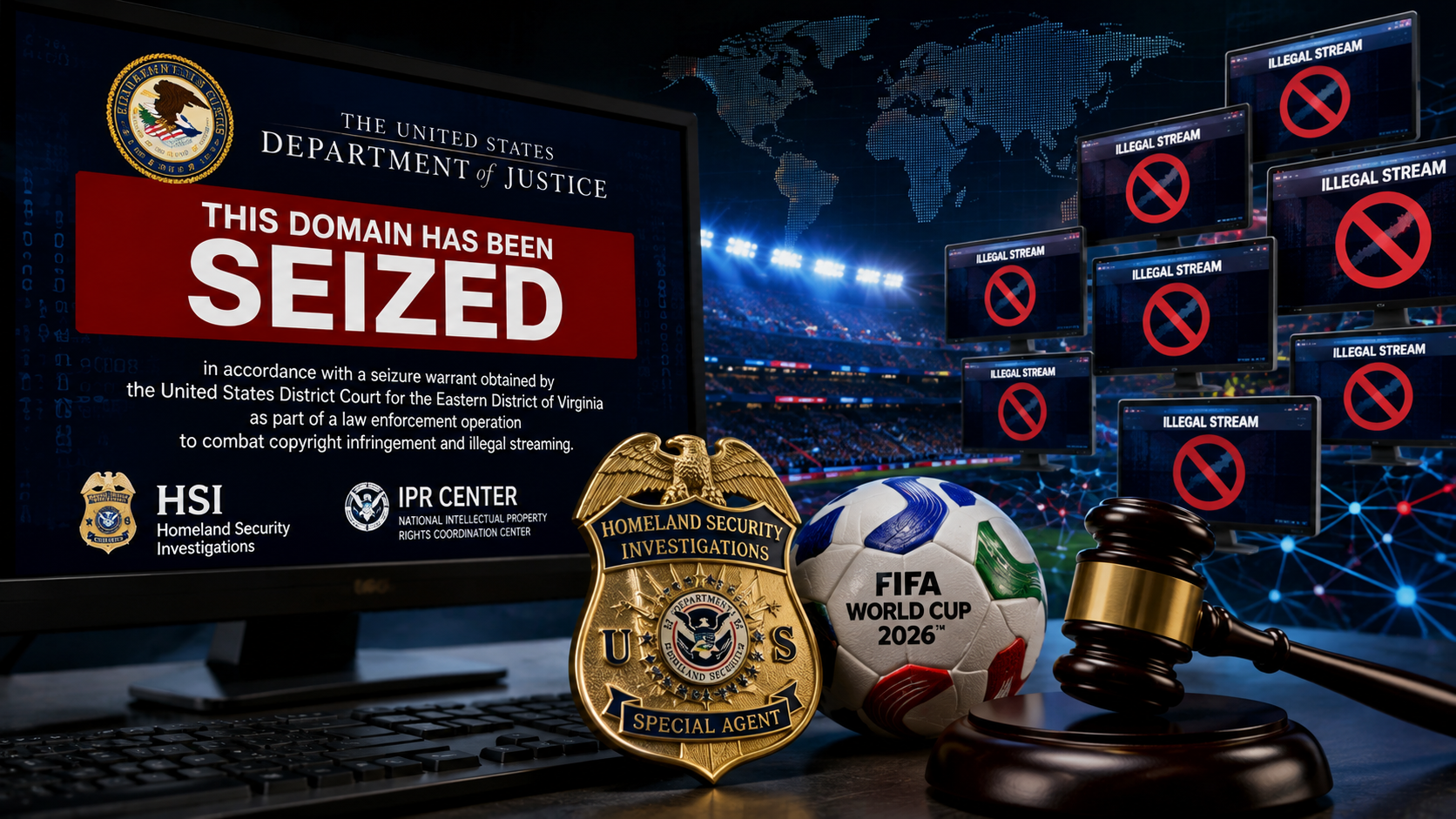


The U.S. Department of Justice (DOJ) has announced one of its largest anti-piracy enforcement actions to date, seizing more than 1,000 internet domains accused of illegally streaming FIFA World Cup 2026 matches. The coordinated operation targeted websites that allegedly broadcast copyrighted matches without authorization, disrupting large-scale digital piracy networks during one of the world’s most-watched sporting events.
The seizures were carried out over three enforcement actions during the FIFA World Cup Finals and included nearly 400 domains taken offline in a separate action announced the previous month. According to federal authorities, the investigation was led by U.S. Immigration and Customs Enforcement (ICE) Homeland Security Investigations (HSI) Washington Field Office together with the National Intellectual Property Rights Coordination Center (IPR Center), with support from several international partners and major media rights holders.
Quick Facts
| Category | Details |
|---|---|
| Enforcement Action | Seizure of more than 1,000 domains |
| Event | FIFA World Cup 2026 |
| Lead Agencies | DOJ, HSI, National IPR Center |
| Primary Allegation | Illegal streaming of copyrighted matches |
| Legal Basis | U.S. Copyright Law |
| International Operation | Operation Red Card |
| U.S. Initiative | Operation Offsides |
Why the DOJ Took Action
Federal investigators allege that the seized domains were broadcasting live FIFA World Cup matches without obtaining authorization from copyright holders.
Unlike legitimate broadcasters that pay substantial licensing fees for exclusive broadcasting rights, piracy websites allegedly redistribute the same content free of charge or through unauthorized subscription services. Authorities argue that these activities undermine intellectual property rights, reduce revenue for broadcasters and sports organizations, and generate profits for criminal operators.
According to court filings submitted in the U.S. District Court for the Eastern District of Virginia, investigators confirmed that many of the targeted websites were actively streaming World Cup matches in real time as they were being officially broadcast.
The DOJ obtained seizure warrants allowing federal agents to redirect the domains, effectively preventing visitors from accessing the allegedly infringing content.
How Domain Seizures Work
A domain seizure does not necessarily remove a website’s underlying servers or operators. Instead, authorities obtain a court order directing the domain registry or registrar to transfer control of the domain name to the U.S. government.
When users attempt to visit the affected website, they are typically redirected to a government seizure notice indicating that the domain has been taken offline pursuant to a federal warrant.
Law enforcement agencies use this approach to quickly interrupt online piracy while continuing investigations aimed at identifying the individuals or criminal groups responsible for operating the platforms.
Operation Offsides Targets Digital Sports Piracy
The U.S. enforcement action forms part of Operation Offsides, an ongoing initiative designed to combat unauthorized online streaming of major sporting events.
You may also like to read : Malaysia’s Asian Cup dreams in jeopardy after FIFA’s bombshell sanctions over 7 falsified player papers
The operation focuses on identifying websites that illegally distribute copyrighted sports broadcasts, obtaining judicial authorization to seize domains, and coordinating enforcement efforts with broadcasters, sports organizations, and international law enforcement agencies.
Officials say the initiative seeks not only to protect intellectual property rights but also to reduce consumer exposure to cyber threats frequently associated with illegal streaming platforms.
Why Illegal Streaming Sites Can Be Risky
Authorities emphasized that copyright infringement is only one concern associated with unauthorized streaming services.
Cybersecurity investigators have repeatedly warned that many illegal streaming websites expose users to additional risks, including:
- Malware infections.
- Phishing attacks.
- Credential theft.
- Payment card fraud.
- Malicious advertising.
- Unauthorized data collection.
Because these platforms operate outside legitimate licensing frameworks, users often have little visibility into how their personal information is collected, stored, or shared.
The DOJ noted that criminals willing to violate copyright laws may also engage in broader forms of cybercrime, making illegal streaming platforms attractive vehicles for malware distribution and financial fraud.
Broad Industry Support for the Investigation
The investigation relied on technical assistance from several organizations that own or protect broadcasting rights.
According to the Department of Justice, supporting information was provided by:
- FIFA.
- beIN Media Group.
- NBCUniversal.
- Warner Bros.
- Ultimate Fighting Championship (UFC).
- Alliance for Creativity and Entertainment (ACE).
These organizations helped investigators identify websites allegedly distributing copyrighted broadcasts without authorization.
Public-private partnerships have become increasingly important in digital piracy investigations because copyright holders often detect unauthorized streams before law enforcement agencies.
International Crackdown Through Operation Red Card
The U.S. action was only one component of a much larger multinational enforcement campaign known as Operation Red Card.
Coordinated through the DOJ’s International Computer Hacking and Intellectual Property (ICHIP) program, authorities across Latin America launched simultaneous operations targeting illegal streaming services and counterfeit World Cup merchandise.
Participating countries included Argentina, Brazil, Chile, Colombia, the Dominican Republic, Ecuador, Paraguay, and Peru.
The coordinated effort resulted in the blocking of hundreds of piracy websites across the region, while Colombian authorities carried out nationwide search operations targeting counterfeit sports apparel and cybercrime networks.
Investigators also arrested members of a cybercriminal organization accused of illegally accessing FIFA’s telecommunications systems and selling pirated streaming services through stolen credentials, virtual private networks (VPNs), and manipulated corporate accounts.
A Growing Focus on Intellectual Property Enforcement
Major international sporting tournaments have increasingly become targets for digital piracy due to their enormous global audiences and high commercial value.
Broadcasting rights for events such as the FIFA World Cup are sold for billions of dollars worldwide, making unauthorized streaming a significant financial concern for broadcasters, advertisers, and sports organizations.
Authorities argue that protecting these rights encourages continued investment in sports broadcasting while supporting jobs across media production, technology, marketing, and event management.
At the same time, law enforcement agencies continue to adapt their strategies as piracy networks become more sophisticated, often using mirror sites, proxy servers, encrypted communications, and rapidly changing domain names to evade detection.
Investigation Continues
The Department of Justice indicated that Operation Offsides remains an active initiative and that additional investigations into digital piracy networks are ongoing.
The Criminal Division’s Computer Crime and Intellectual Property Section (CCIPS) is assisting prosecutors and investigators throughout the operation. In addition to pursuing criminal prosecutions, CCIPS works closely with domestic and international partners to investigate cybercrime, intellectual property offences, and online criminal enterprises.
Since 2020, the section has secured convictions against more than 180 cybercrime and intellectual property offenders while helping recover hundreds of millions of dollars for victims through court-ordered restitution and asset recovery.
Summary
The seizure of more than 1,000 domains represents one of the largest coordinated actions against illegal sports streaming linked to the FIFA World Cup. By combining court-authorized domain seizures with international cooperation under Operations Offsides and Red Card, U.S. and foreign authorities aim to disrupt digital piracy networks while protecting broadcasters’ intellectual property rights. The case also highlights the broader cybersecurity risks associated with unauthorized streaming platforms, reinforcing law enforcement’s message that viewers should rely on legitimate broadcasting services for major sporting events.